How to Spot 'Smart Money' on Polymarket Before a Market Resolves
Here is a hard truth most traders refuse to accept: volume is a lie.
You see a market with $2 million in trading volume and assume it must be a high-conviction battleground. Smart people are duking it out, right? Not necessarily. That volume could be wash trading. It could be market makers collecting spread with zero directional conviction. It could be a bunch of retail traders buying 95-cent favorites for pennies.
The question that actually matters is not "how much money is in this market?" but rather "whose money is in this market?"
This distinction separates traders who consistently extract value from prediction markets from those who are just along for the ride. Smart money does not announce itself. It does not post on Twitter before taking a position. But it does leave fingerprints on-chain, and those fingerprints are readable if you know what to look for.
This guide explains how PolyAlertHub's advanced analytics identify smart money activity in real time. We will cover the scoring methodology, the contrarian signals, the behavioral indicators, and the fresh wallet detection that can surface fresh wallet activity before it becomes obvious to everyone else.
What You Will Learn
- Why volume and position size are misleading proxies for skill
- How the Smart Money Flow Index scores traders based on actual performance
- The Inverse Cramer Indicator: what the worst traders are doing (and why you should care)
- Diamond Hands vs. Paper Hands: reading conviction through behavior
- Fresh Wallet Analysis: detecting potential fresh wallet activity before it moves markets
The Problem: Why "Big Money" Is Not "Smart Money"
Most whale tracking tools make the same fundamental error. They equate size with intelligence. A wallet with $500,000 in trading volume gets flagged as a "whale" regardless of whether that trader is up $200,000 or down $300,000 lifetime.
This is backwards. The point of tracking large traders is to gain informational edge. Following a wealthy idiot is worse than useless because it actively misleads you.
Consider what "big money" can actually mean:
Market Makers: These traders provide liquidity by placing orders on both sides of the book. They profit from spread, not from predicting outcomes. A market maker might execute $10 million in volume annually while having precisely zero view on which candidate wins an election.
Hedgers: Wealthy individuals sometimes use prediction markets to hedge real-world risk. A venture capitalist with significant crypto exposure might buy "Crypto market cap down" as insurance. Their bet does not reflect their prediction. It reflects their portfolio construction.
Dumb Money with Deep Pockets: Some wallets simply have more capital than skill. They may be funded by proceeds from elsewhere (inheritance, early crypto holdings, successful exits in unrelated fields) and their prediction market track record is mediocre or worse.
Wash Traders: Especially in lower-liquidity markets, coordinated trading between related wallets can inflate volume artificially. This might be done to manipulate perception, to farm potential airdrops, or simply to create the illusion of market activity.
None of these categories offer any trading edge. Following them guarantees nothing except correlated exposure to traders who may know less than you do.
Real smart money identification requires one thing: historical results. A trader is "smart money" if they have demonstrated consistent profitability across a meaningful sample of trades. Everything else is noise.
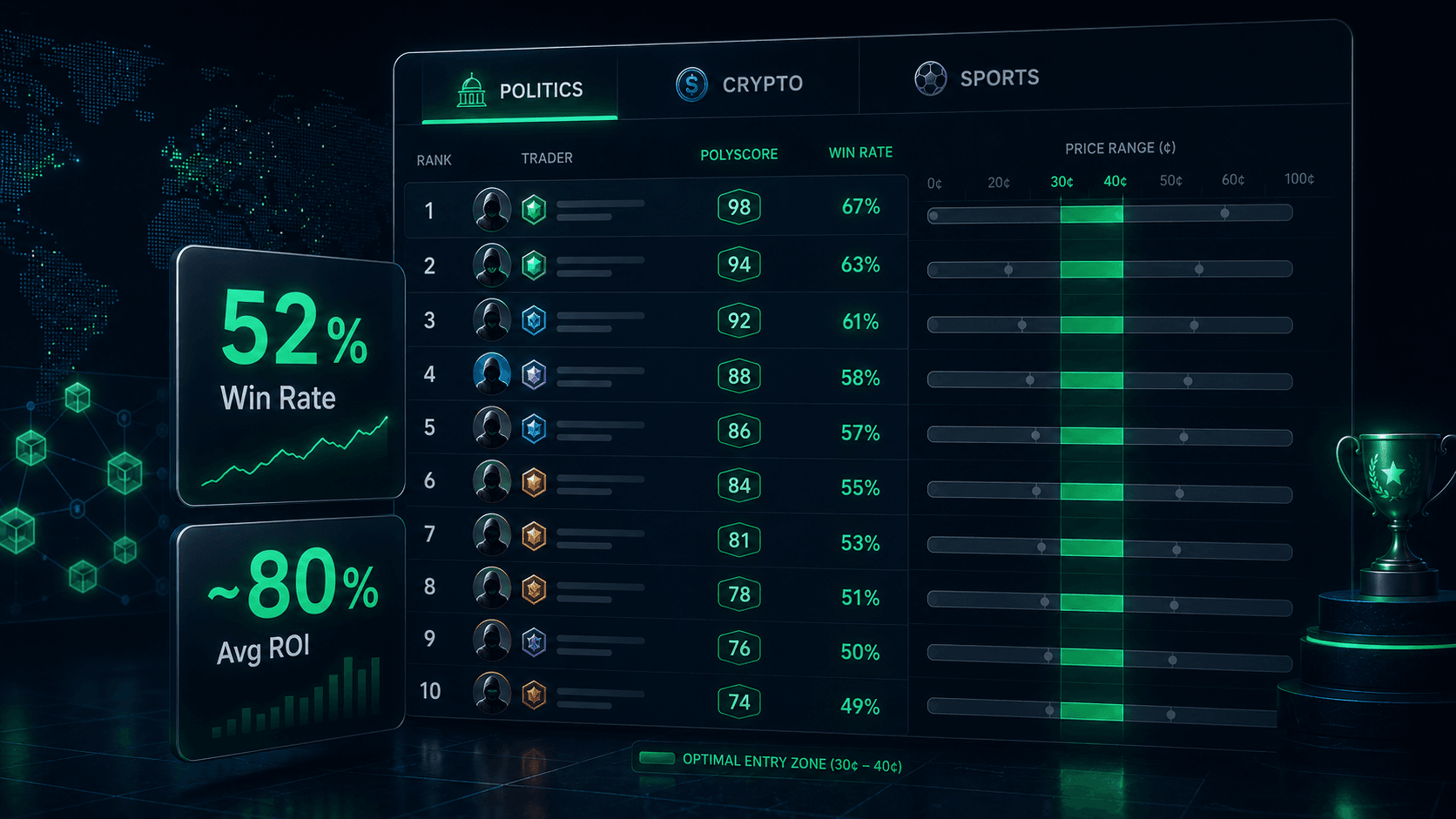
At PolyAlertHub, we calculate a proprietary Smart Money Score for each trader based on several weighted factors:
Win Percentage: What proportion of their trades ultimately resolved in profit? This matters, but alone it can be gamed by betting on near-certainties.
Net Realized PnL: Total profit and loss across all resolved positions. This is the bottom line, what did they actually take home? We use logarithmic scaling to handle the wide distribution (a $10,000 profit and a $1,000,000 profit should not be treated linearly).
Average PnL Per Trade: Consistency matters. A trader who makes $500 on every trade is more predictable than one who makes $50,000 once and loses $45,000 over the next 50 trades.
Markets Traded: Experience across diverse markets indicates skill rather than luck. Someone profitable across political, crypto, and sports markets has demonstrated genuine edge.
Current Unrealized PnL: How are their open positions performing? This provides a real-time signal about their current reads.
The resulting score ranges from 0 to 100. Traders scoring above 75 are exceptional performers. Traders scoring below 25 have consistently lost money. Everyone in between represents various degrees of mediocrity.
Key Insight: The Smart Money Score is not about predicting the future. It is about identifying wallets with proven track records. Past performance does not guarantee future results, but it is a far better filter than wallet size.
The Smart Money Flow Index: Who Is Actually Positioned?
Once you can score individual traders, the next step is aggregating that intelligence at the market level. For any given outcome (say, "Yes" on a particular market), we calculate the Smart Money Flow Index. This tells you:
-
What percentage of shares are held by high-scoring traders? If 60% of "Yes" shares are held by wallets with Smart Money Scores above 70, that is a strong signal. If 60% are held by wallets scoring below 30, that is equally important information in the opposite direction.
-
What is the average Smart Money Score of all holders? This gives a single number representing the collective "intelligence" of the capital on one side of a market.
-
Who are the top smart money holders? You can drill down to see the specific wallets with the best track records and examine their position sizes.
This approach inverts the typical whale tracking paradigm. Instead of asking "who has the most money here?", you ask "who has the best track record here?" The answers are often surprisingly different.
Practical Application:
Imagine you are evaluating a market on whether a specific piece of legislation will pass. The "Yes" side is trading at 45 cents. Volume looks balanced. Nothing obvious in the order book.
But the Smart Money Flow Index shows that 72% of "Yes" shares are held by traders with an average Smart Money Score of 81. Meanwhile, the "No" side shows only 34% smart money concentration with an average score of 52.
The smart money has quietly accumulated on "Yes" while the broader market remains unconvinced. This is exactly the kind of divergence that precedes resolution moves.
The Inverse Cramer Indicator: Fading the Worst Traders
There is a running joke in traditional finance about doing the opposite of what Jim Cramer recommends. The theory is that certain public figures are so consistently wrong that their picks become useful contrarian signals.
In prediction markets, we do not need to rely on media personalities. We have actual performance data. And the bottom performers are often just as informative as the top performers.
We call this the Inverse Cramer Indicator. It tracks what the worst-performing traders (those with the lowest Smart Money Scores) are doing in any given market. These "Naive Money" traders have demonstrated consistent ability to be wrong.
The indicator includes:
- Naive Money Share Percentage: What proportion of shares on each side are held by bottom-tier performers?
- Naive Money Investment: How much capital have the worst traders committed?
- Smart-to-Naive Ratio: The ratio of smart money investment to naive money investment on each side.
Why This Matters:
When naive money is heavily concentrated on one side of a market, it creates potential contrarian opportunity. These traders have proven track records of misjudging outcomes. Their collective conviction is anti-signal.
The indicator does not tell you to blindly fade retail. But when you see 80% of "Yes" shares held by wallets with an average Smart Money Score of 22, while only 15% of "No" shares show similar naive concentration, you have useful information.
Practical Example:
A political market is pricing an outcome at 55% "Yes." The mainstream narrative supports this pricing. Polls look reasonable. Nothing obviously wrong.
But the Inverse Cramer Indicator shows massive naive money concentration on "Yes":
- Naive money holds 67% of "Yes" shares
- Average score of "Yes" holders: 28
- Smart-to-Naive ratio on "Yes": 0.4
Meanwhile, the "No" side looks different:
- Naive money holds only 23% of "No" shares
- Average score of "No" holders: 64
- Smart-to-Naive ratio on "No": 2.8
The worst traders are crowded into "Yes." The best traders quietly prefer "No." This divergence, invisible in price and volume data, reveals the true distribution of informed capital.
Diamond Hands vs. Paper Hands: Reading Conviction Through Behavior
Even among traders who are positioned correctly, conviction varies enormously. Some will hold through volatility until resolution. Others will panic sell at the first adverse move. Understanding this distinction matters because it reveals how "sticky" the current positioning is.
Our Behavioral Sentiment Analysis examines holder behavior patterns to calculate:
Conviction Score: A composite measure of how committed current holders are to their positions. Higher scores indicate that holders are likely to maintain positions through volatility.
Market Behavior Classification: We categorize each market into one of four behavioral states:
- High Conviction: Holders are sitting tight with minimal profit-taking
- Profit Taking: Holders are selling into strength, reducing positions as prices rise
- Panic Selling: Holders are dumping positions at losses, creating potential buying opportunities
- Mixed: No clear behavioral pattern emerges
Diamond-to-Paper Ratio: The ratio of long-term holders (those maintaining positions through volatility) to short-term traders (those who exit quickly).
Early Profit Takers: Count of holders who sold positions at small gains rather than holding for full resolution.
Panic Sellers: Count of holders who sold at significant losses, indicating low conviction.
Why Behavioral Sentiment Matters:
Price tells you where the market is. Behavioral sentiment tells you how stable that price is likely to be.
A market at 65 cents with high conviction and a 4:1 diamond-to-paper ratio will behave very differently from a market at 65 cents where most holders are early profit takers. The first market has resilient positioning. The second is vulnerable to cascading sells if any negative news hits.
This analysis also reveals potential entry points. When you see elevated panic selling in a market you believe is undervalued, you know there is available supply from weak hands looking to exit. You can potentially enter at better prices than the current order book suggests.
Fresh Wallet Analysis: Detecting Suspicious Activity
Here is a pattern that should make you pay attention: a niche market with relatively low volume suddenly receives significant capital from brand-new wallets.
Fresh wallets are addresses with minimal history on the platform. They might have been created within the last 24 to 48 hours. When these wallets start taking large positions in a specific market, something unusual is happening.
Our Fresh Wallet Analysis tracks:
- Fresh 24h Volume Percent: What proportion of recent trading volume comes from wallets less than 24 hours old?
- Fresh 48h Volume Percent: Same calculation with a 48-hour window.
- Fresh Wallet Count: How many brand-new wallets are active in this market?
- Fresh Wallet Holdings: Total value held by fresh wallets.
- Alert Level: Classified as Normal, Warning, or Critical based on concentration.
Interpreting Fresh Wallet Signals:
Normal markets show fresh wallet activity in the low single digits. New users join prediction markets constantly, so some fresh wallet activity is expected.
A Warning level (elevated fresh wallet concentration) suggests something is drawing new money to a specific market. This might be organic (the market went viral on social media) or it might indicate coordinated activity.
A Critical alert (very high fresh wallet concentration) in a niche market is a significant signal. Why would dozens of brand-new wallets suddenly care about an obscure outcome? Possible explanations include:
- Information Asymmetry: Someone with private information is distributing their activity across multiple fresh wallets to disguise their size.
- Coordinated Manipulation: A group is attempting to move the market through concentrated buying.
- Bot Activity: Automated systems are deploying capital based on some external trigger.
None of these explanations are necessarily good or bad for your trade. But all of them are worth knowing about.
Practical Application:
You notice a market on a relatively obscure regulatory decision. Volume has been low for weeks. Suddenly, our Fresh Wallet Analysis shows:
- 34% of 24h volume from fresh wallets (Critical)
- 12 new wallets active in the last day (versus 2 per day historical average)
- Fresh wallet holdings totaling $47,000
Something changed. Maybe someone knows how the regulatory body will rule. Maybe someone is trying to pump the market before dumping. Either way, you now have information that was invisible in the standard price and volume data.
Putting It Together: A Decision Framework
These analytics are tools, not answers. Smart money can be wrong. Fresh wallet alerts can be false positives. The Inverse Cramer Indicator is a filter, not a trading signal.
Here is a practical framework for incorporating these insights:
Step 1: Start With Your Own Analysis
Before checking any smart money metrics, form your own view. What do you believe the probability should be? Why? Having an independent opinion prevents you from simply outsourcing your thinking to aggregate data.
Step 2: Check Smart Money Alignment
Does the Smart Money Flow Index support your thesis? If smart money is aligned with your view, you have confirmation from historically profitable traders. If smart money opposes your view, that does not mean you are wrong, but it should prompt additional scrutiny.
Step 3: Examine the Inverse Cramer
Where is the naive money concentrated? If retail is crowded on the opposite side of your trade, you have additional contrarian support. If retail is crowded on the same side as your trade, you are running with the herd, which is not inherently bad but removes one potential edge.
Step 4: Assess Behavioral Conviction
Is the positioning on your side of the trade stable? High conviction and low panic selling suggest your allies will hold through volatility. Low conviction suggests price might be less stable than it appears.
Step 5: Review Fresh Wallet Activity
Any unusual patterns? If fresh wallet concentration is elevated on one side, factor that into your sizing and conviction level. You might have an informational edge, or you might be walking into a trap.
Step 6: Size Appropriately
Even with all signals aligned, prediction markets carry significant risk. Smart money has losing streaks. Retail occasionally gets it right. Fresh wallet alerts sometimes mean nothing. Use these analytics to improve your expected value, not to bet the farm on any single trade.
Where to Access These Analytics
PolyAlertHub provides these advanced analytics through the Market Analytics Dashboard, which feeds directly into our Smart Money Tracker. Each market includes:
- Smart Money Flow breakdown by outcome
- Inverse Cramer Indicator readings
- Behavioral Sentiment classification
- Fresh Wallet alerts when detected
Premium subscribers receive additional granularity, including individual trader Smart Money Scores, historical positioning data, and custom alerting based on smart money movements. For the standalone insider surface, see the Polymarket Fresh Wallet Tracker.
The Top Traders Leaderboard lets you explore individual wallet performance and filter by Smart Money Score to identify the traders worth watching.
Whale Alerts notify you when high-scoring traders take significant positions, cutting through the noise of general market activity.
Final Thoughts
The edge in prediction markets belongs to those who understand what the data is actually saying. Volume is vanity. Position size is surface-level. What matters is the quality of the capital on each side of a trade.
Smart money identification is not about finding a magic indicator that makes trading easy. It is about adding another dimension to your analysis, one that most participants ignore entirely. While the majority chase volume spikes and follow famous wallets regardless of track record, you can focus on the traders who have demonstrated actual skill.
The Inverse Cramer Indicator takes this further by showing you where the consistent losers are positioned. Behavioral sentiment reveals whether current holders will stand firm or fold under pressure. Fresh wallet analysis surfaces unusual activity before it becomes obvious to everyone.
None of these tools replace thinking. But in a market where the other side might have better information, faster data feeds, or simply more experience, every legitimate edge compounds.
Disclaimer: The content provided in this article and via the PolyAlertHub tools is for informational purposes only. It does not constitute financial, investment, or trading advice. Prediction markets carry high risk, and you should never wager more than you can afford to lose.