Top Polymarket Trading Strategies for 2026
Prediction markets have matured considerably since their early days. In 2026, Polymarket stands as the dominant platform where traders exchange real capital based on their beliefs about future events. From political elections to cryptocurrency price movements, from sports outcomes to scientific breakthroughs, these markets offer something traditional financial markets cannot: direct exposure to the probability of specific events occurring.
The question for most traders is not whether to participate, but how to participate profitably. Simply buying what you believe will happen is a start, but it leaves significant edge on the table. Professional traders approach Polymarket with specific strategies designed to extract value from market inefficiencies, and these techniques are increasingly accessible to intermediate and advanced traders willing to learn.
This guide presents the most effective Polymarket trading strategies for 2026. Each strategy includes practical implementation guidance, specific scenarios where it works best, and honest discussion of the risks involved. By the end, you will have a toolkit of approaches that can be combined and adapted to your trading style.
How Polymarket Works
Before exploring strategies, a quick primer on the mechanics. Polymarket operates as a prediction market where outcomes are priced between $0.00 and $1.00. These prices represent the market's collective probability estimate. A market trading at $0.65 means traders, in aggregate, believe there is a 65% chance that outcome will occur.
When events resolve, winning shares pay out $1.00. Losing shares become worthless. This creates the fundamental trading dynamic: if you believe an outcome has a higher probability than the market price suggests, buying shares offers positive expected value. If you believe the probability is lower than the market implies, selling or buying the other side is the profitable play.
The catch is that the market represents the aggregated view of all participants, including professionals with research teams, insiders with privileged information, and algorithms scanning news feeds 24/7. Beating this collective intelligence requires either better information, faster execution, or systematic approaches that exploit structural inefficiencies.
That is where strategy comes in.
Strategy 1: Arbitrage Opportunities
Arbitrage is the closest thing to "free money" in trading. It involves exploiting price discrepancies that should not exist according to basic logic. In prediction markets, these opportunities arise in two primary forms.
When the same event is listed on multiple prediction market platforms, prices occasionally diverge. If Polymarket prices "Candidate A wins election" at $0.58 while another platform prices the same outcome at $0.52, you can theoretically buy on the cheaper platform and sell on Polymarket, locking in profit regardless of the outcome.
When to use this strategy:
- When you have accounts on multiple prediction market platforms
- When you can move capital quickly between platforms
- When the price discrepancy exceeds transaction fees on both platforms
Pros:
- Near-zero directional risk when executed correctly
- Profits are locked in at the time of trade
- Does not require predicting the outcome correctly
Cons:
- Opportunities are rare and disappear quickly
- Withdrawal and deposit delays can eliminate the edge
- Transaction fees often exceed the theoretical profit
- Requires capital on multiple platforms simultaneously
Intra-Market Arbitrage
Polymarket offers a more accessible form of arbitrage within the platform itself. When a market has multiple possible outcomes, the sum of all outcome prices should equal approximately $1.00 (accounting for the spread). When prices deviate from this, arbitrage opportunities emerge.
For example, consider a market with three candidates: A, B, and C. If their prices are $0.28, $0.35, and $0.32, the total is $0.95. By buying all three outcomes at their current prices, you pay $0.95 upfront but when one of them wins you receive $1.0. This is a guaranteed return.
Example in practice:
Market: "Who will win the 2026 Senate race?"
- Candidate A: $0.28
- Candidate B: $0.35
- Candidate C: $0.32
- Total: $0.95
By buying $100 worth of shares in each outcome (relative to their prices), you lock in $5 profit regardless of who wins.
Strategy 2: Momentum and Mean Reversion Trading
Markets do not move in straight lines. Understanding when to follow trends and when to bet against them is a core skill for any serious trader.
Momentum Trading
When significant news breaks, markets often underreact initially and then adjust over hours or days. The first traders to identify the implications of new information can ride the price adjustment.
When to use this strategy:
- After breaking news that clearly changes the probability of an outcome
- When you see large informed traders (whales) entering positions aggressively
- During slow-burn news cycles where full implications take time to be understood
Pros:
- Captures value from information that is technically public but not fully priced
- Can generate large returns on major news events
- Works across all market categories
Cons:
- Requires constant market monitoring or effective alert systems
- Risk of "chasing" trades after the move has already happened
- Breaking news can be misleading or reversed
Mean Reversion Trading
Markets sometimes overreact to news, pushing prices to extremes that are not justified by the actual probability change. Mean reversion traders identify these overreactions and bet on prices returning toward fair value.
When to use this strategy:
- After panic selling or euphoric buying spikes
- When prices move sharply on low-quality or preliminary information
- In highly liquid markets where temporary imbalances correct quickly
Example:
A candidate faces a scandal and their win probability drops from $0.48 to $0.28 within an hour based on a single unverified tweet. If your analysis suggests the scandal is minor or will be forgotten, buying at $0.28 captures value as the market recalibrates.
Pros:
- Contrarian approach that captures emotional overreactions
- Often offers better entry prices than patient waiting
- Can be combined with other strategies
Cons:
- "Overreaction" is subjective and difficult to measure
- Sometimes what looks like overreaction is actually correct pricing
- Requires confidence to trade against prevailing sentiment
Strategy 3: High-Probability Trades and Bonding
When outcomes are nearly certain but not yet resolved, their prices approach but never quite reach $1.00. Buying shares at $0.95 to receive $1.00 upon resolution offers a 5.26% return. This is sometimes called "bonding" because you are essentially lending capital until the event resolves. PolyAlertHub maintains a dedicated Bond Markets list that surfaces high-certainty opportunities across all active markets, making it easy to identify these trades without manual scanning.
When to use this strategy:
- Late-stage elections where outcomes are clear but not officially called
- Events with known outcomes waiting for formal confirmation
- Markets where resolution is imminent (hours or days away)
Practical example:
An election has been called by all major news outlets for Candidate A, but the market has not resolved yet. Shares are trading at $0.97. Buying at this price yields approximately 3% return when the market settles.
Pros:
- Very low risk when the outcome is genuinely certain
- Provides consistent returns on capital
- Can be scaled with significant capital
Cons:
- Returns are small in absolute terms
- Capital is locked until resolution
- Unexpected reversals (however rare) can be catastrophic
- Transaction fees can eliminate thin margins
Strategy 4: Early Entry and Value Investing
New markets are often inefficient. Prices in the first hours or days after a market launches may not reflect careful analysis by sophisticated participants. Early entry allows you to establish positions before the "smart money" arrives. Staying ahead of new market launches is critical for this strategy, which is why setting up new market alerts can give you a significant edge by notifying you the moment interesting markets go live.
When to use this strategy:
- On markets covering topics you have genuine expertise in
- On new markets that large traders may not notice immediately
- When you identify a market that is clearly mispriced based on public information
Key considerations:
The challenge with early entry is liquidity. New markets often have thin order books, meaning large orders will move the price significantly against you. Size your positions appropriately and use limit orders rather than market orders.
Pros:
- Captures the largest mispricings before they correct
- Your analysis is competing against a smaller pool of participants
- Positions have time to develop as the market matures
Cons:
- Low liquidity makes entry and exit expensive
- Price discovery is volatile in new markets
- Less data available for analysis
Strategy 5: Whale Tracking and Copy Trading
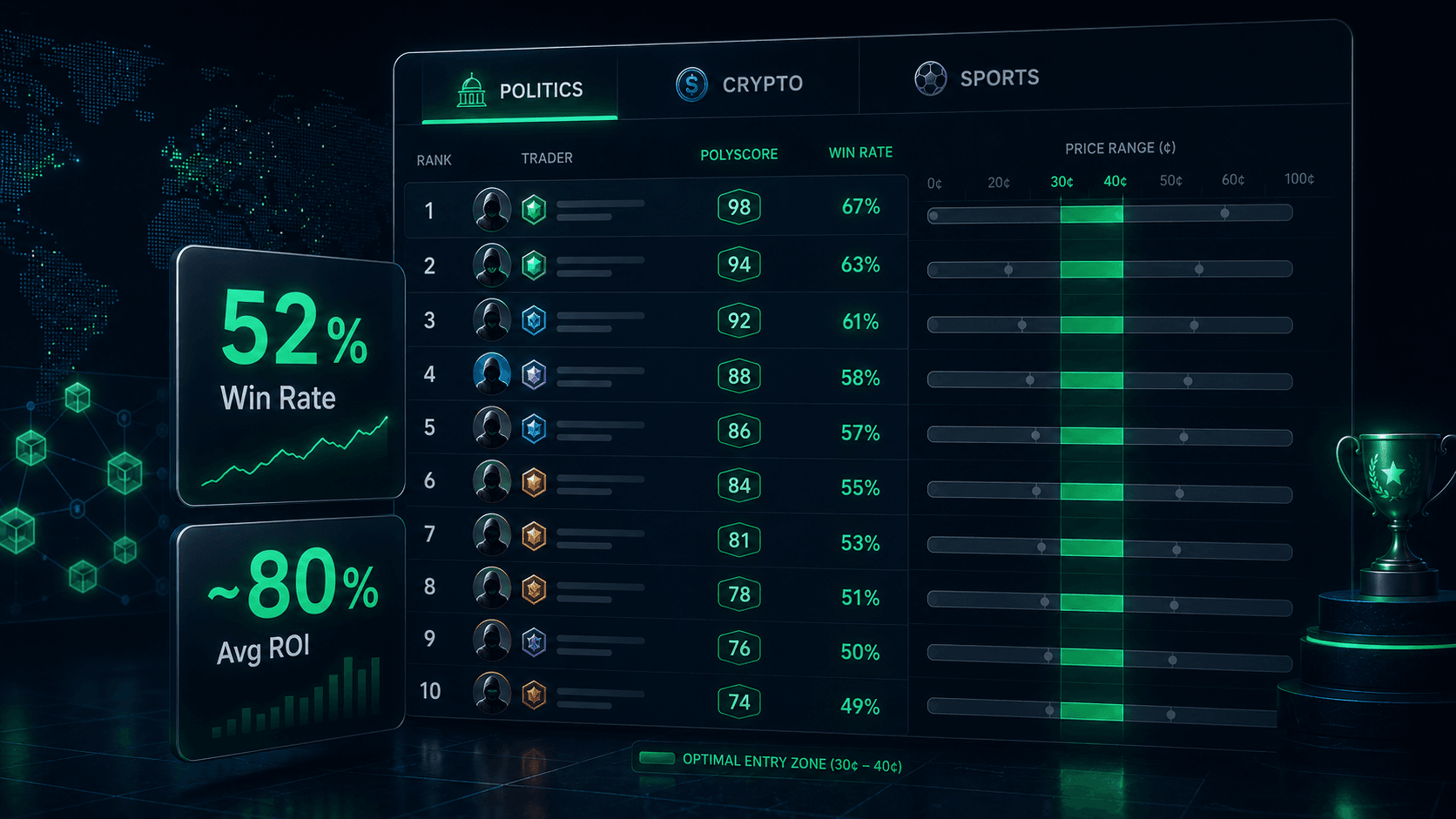
Some traders consistently outperform the market. Their wallets contain a record of every trade they have made, and on blockchain-based platforms like Polymarket, this information is public. Tracking these "whales" and following their positions is a legitimate strategy, though it requires nuance. The Top Traders leaderboard ranks wallets by profitability, while the Whales Live Feed shows large trades as they happen in real time.
When to use this strategy:
- When multiple top-performing wallets converge on the same position
- When whale activity precedes news or price movements
- As a confirmation signal for trades you were already considering
The key insight is that tracking a single whale is unreliable. Whales hedge, experiment, and make mistakes. What matters is consensus: when several independent smart wallets take the same directional position within a short time window, the signal is much stronger.
How to implement:
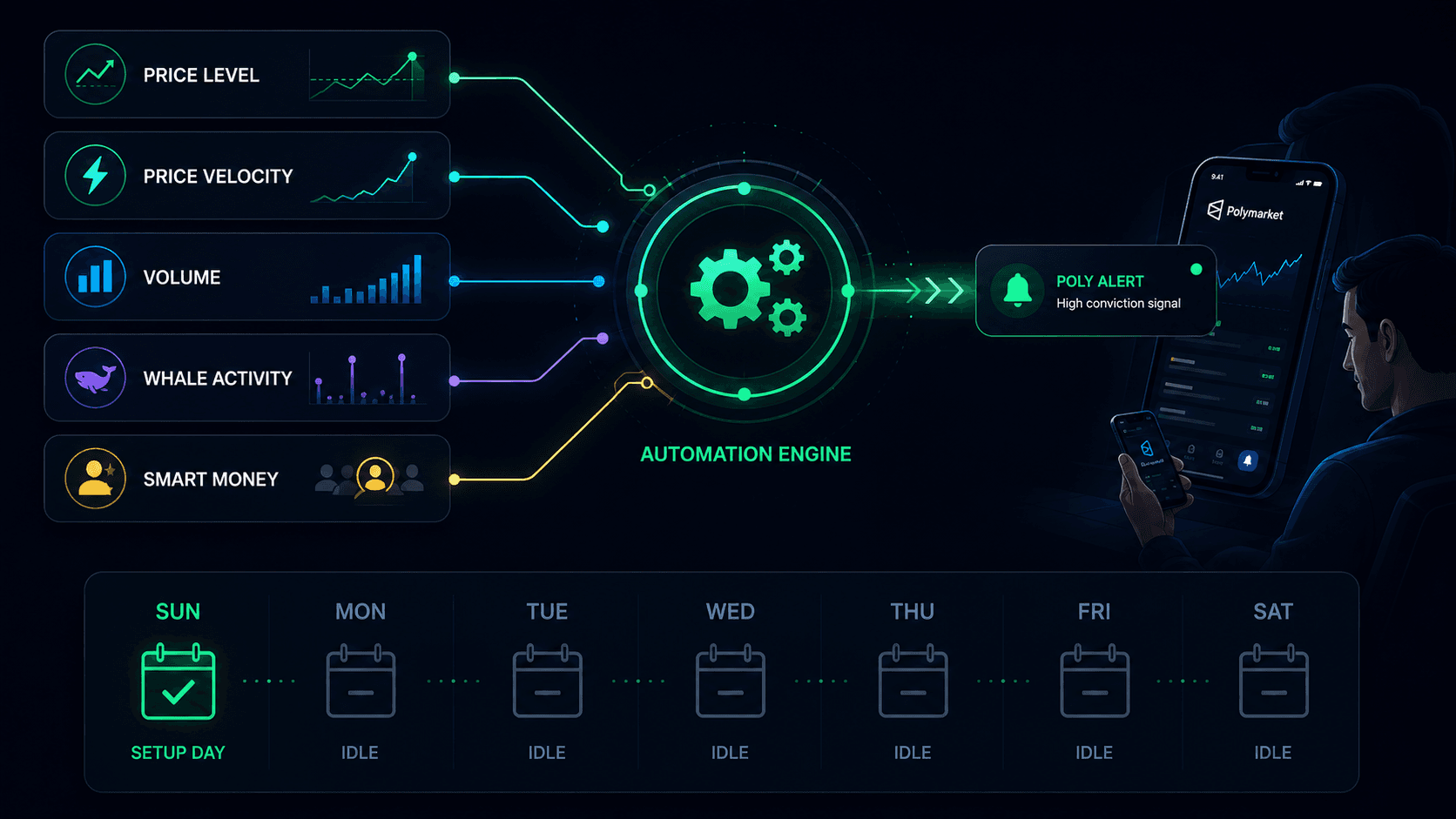
Platforms like PolyAlertHub provide Polymarket Whale Alerts that monitor large trader activity and surface convergence signals. Instead of manually watching dozens of wallets, you receive alerts when smart money aligns.
Pros:
- Leverages the research and information advantages of professional traders
- Consensus signals have strong predictive value
- Reduces the analytical burden on individual traders
Cons:
- Whales can be wrong
- Following too closely creates delayed entries after prices have moved
- Does not replace independent analysis
Strategy 6: News-Driven Scalping and Market Reactions
Prediction markets are extraordinarily sensitive to news. Political announcements, earnings releases, legal decisions, and sporting events create predictable windows of volatility. Scalpers position themselves to capture quick profits during these windows.
When to use this strategy:
- During scheduled events (debates, hearings, earnings calls)
- When you have faster access to information sources than the average trader
- In markets with high liquidity where entries and exits are efficient
Practical approach:
Before a scheduled event, identify markets that will be affected. Establish small positions or set limit orders at prices you believe represent overreaction levels in either direction. As the event unfolds and prices spike, execute your trades and take profits quickly.
Example:
A presidential debate is scheduled for 9 PM. You identify two likely scenarios: the incumbent performs well (price rises to $0.60) or poorly (price drops to $0.40). Current price is $0.50. You place limit orders to sell at $0.58 and buy at $0.42, capturing value from the initial overreaction before the market settles.
Pros:
- Volatility creates opportunity
- Predictable timing allows preparation
- Works in both directions regardless of outcome
Cons:
- Requires fast execution
- Slippage can eliminate profits
- Events may produce unexpected outcomes that overwhelm your position
Strategy 7: Order Book Imbalance and Spread Farming
For more technically-oriented traders, the order book itself contains valuable signals. When buy orders significantly outweigh sell orders (or vice versa), it often precedes price movement in that direction. The PolyAlertHub Markets page provides order book analysis for every active market, showing bid/ask depth and imbalance indicators that would otherwise require manual calculation.
Order Book Analysis
Monitoring the ratio of resting bid orders to ask orders reveals directional pressure before it manifests in price changes. Large imbalances suggest that one side of the market is more aggressive.
When to use this strategy:
- In liquid markets where order book data is reliable
- When you can monitor order books in real time
- As a supplementary signal to other strategies
Spread Farming
Markets with wide bid-ask spreads offer opportunities for patient traders. By placing limit orders on both sides of the book and waiting for fills, you capture the spread without taking directional risk.
Example:
A market has a best bid of $0.48 and a best ask of $0.52. By placing a buy order at $0.49 and a sell order at $0.51, you earn $0.02 per share if both orders fill. This is market making in its simplest form.
Pros:
- Profits without predicting direction
- Works in low-volatility environments
- Scales with capital and patience
Cons:
- Requires constant order management
- Directional moves can leave you holding losing positions
- Competition from professional market makers is intense
Risk Management for Polymarket Traders
No strategy discussion is complete without addressing risk. Prediction market trading involves real capital, and losses compound quickly without proper controls.
Position Sizing
Never risk more than 5% of your trading capital on a single position. Many successful traders keep individual positions under 2%. This ensures that even a string of losses will not eliminate your ability to trade.
Diversification
Spread your capital across multiple uncorrelated markets. Political markets, crypto markets, and sports markets often move independently. A diversified portfolio reduces the impact of any single loss.
Stop Losses and Take Profits
Define your exit points before entering a trade. If you buy at $0.40 expecting a rise to $0.60, decide in advance: at what price will you cut your losses? At what price will you take profits? Emotional decisions during drawdowns are rarely optimal. While Polymarket does not have native stop-loss orders, you can replicate this discipline by setting price alerts at your predetermined exit levels so you never miss a critical threshold.
Bankroll Management
Treat your Polymarket capital as a dedicated bankroll separate from your living expenses. Calculate your edge over time and size bets accordingly. Even profitable strategies experience drawdowns, and adequate reserves are necessary to survive them.
Liquidity Awareness
Illiquid markets are dangerous. A position that looks profitable on paper can become a trap if you cannot exit at reasonable prices. Always check order book depth before sizing your position.
Conclusion: Building Your Trading Edge
The strategies presented here are not mutually exclusive. Professional Polymarket traders typically combine several approaches: using whale tracking signals to confirm momentum trades, applying mean reversion logic after initial scalps, and running perpetual arbitrage scans across their watched markets.
The common thread is systematic thinking. Rather than trading on gut feeling, successful traders develop repeatable processes. They know their edge, size their bets accordingly, and maintain discipline through inevitable losing streaks.
For traders ready to implement these strategies, the right tools matter. PolyAlertHub provides the infrastructure to execute:
The markets will continue to evolve, and new strategies will emerge. What remains constant is the value of disciplined execution, continuous learning, and respect for risk. Master these fundamentals, and the specific tactics become variations on a proven theme.
Start with one strategy, practice until it becomes second nature, and then expand your repertoire. The edge is always going to be there for traders willing to do the work.
Frequently Asked Questions
What is the easiest strategy for beginners?
High-probability trading (bonding) is the most approachable strategy for beginners. The Bond Markets section on PolyAlertHub shows you markets where outcomes are nearly certain but not yet resolved. Buy shares at prices like $0.95 to $0.98 and wait for the $1.00 payout. The returns are modest but the risk is low, and the mechanics are straightforward. As you become comfortable with the platform, gradually incorporate other strategies like whale tracking and mean reversion.
Can arbitrage really be profitable after fees?
Yes, but marginally and rarely. Pure cross-platform arbitrage opportunities that exceed fees are uncommon and disappear within minutes or seconds. Intra-market arbitrage (exploiting outcome price sums that are below $1.00) is somewhat practical but requires fast execution and careful fee calculation. Most retail traders find that arbitrage is better understood as a concept for identifying mispricings rather than a primary profit source. The real value is recognizing when prices are "wrong" and combining that insight with other strategies.
How do I track whales on Polymarket?
Several approaches exist. The manual method involves identifying top-performing wallets from the PolyAlertHub Top Traders page, then monitoring their on-chain activity using blockchain explorers. This is time-intensive and requires technical knowledge.
The practical method is using dedicated tracking tools. PolyAlertHub offers whale alerts and whale consensus signals that automatically detect when multiple top traders converge on the same position. Setting up alerts for these convergence events delivers the signal directly to your inbox or Telegram without requiring constant monitoring.
For developers, the PolyAlertHub API provides programmatic access to whale activity data, enabling automated copy trading systems. The API documentation covers endpoints for fetching whale trades, consensus signals, and unusual activity patterns.
How much capital do I need to start trading on Polymarket?
You can start with as little as $50 to $100 for learning purposes. However, small accounts face proportionally higher friction from transaction fees and minimum order sizes. Most serious traders recommend starting with at least $500 to $1,000, which provides enough capital to diversify across multiple positions while keeping fees manageable as a percentage of returns.
Are prediction market profits taxable?
Yes, in most jurisdictions prediction market profits are taxable income. The specific classification (gambling winnings, capital gains, or ordinary income) varies by country and region. Consult a tax professional familiar with your jurisdiction's treatment of prediction markets and cryptocurrency-based trading platforms.
What is the most common mistake new traders make?
Overconfidence in their predictions. New traders often assume their personal beliefs about an outcome are more accurate than the market price implies. Remember that the market price reflects the aggregated view of all participants, including professionals and insiders. The market is often right, especially in liquid markets on major events. Successful trading requires humility: your edge comes from process and discipline, not from being smarter than everyone else on every trade. Before risking real capital, consider using paper trading to test your strategies and calibrate your confidence against actual market outcomes.