5 Common Mistakes New Polymarket Traders Make (And How to Avoid Them)
Here is the uncomfortable part of prediction markets nobody tells you when you sign up: most new traders lose money in their first month, and almost all of them lose money for the same five reasons.
It is not because the markets are rigged. It is not because the whales are smarter than you (although some are). It is because prediction markets punish a very specific set of cognitive habits that feel completely natural to a human being. Buying what you "believe in." Doubling down on a loser. Chasing a market that is already running. These reflexes work fine in everyday life. On Polymarket they will quietly drain your balance.
The good news is that every one of these mistakes is fixable. You do not need a quant background or insider information to avoid them. You need a checklist and the discipline to follow it.
This guide walks through the five most common mistakes new Polymarket traders make, why each one is so easy to fall into, and exactly what to do instead.
What You Will Learn
- Why "betting on what you want" is the fastest way to bleed an account
- How to read liquidity before you enter a position
- The FOMO trap and how to spot it on a price chart
- Why holding losers is more expensive than you think
- How to use whale data without becoming a blind copy trader
Mistake 1: Betting on What You Want to Happen
This is the original sin of prediction markets.
You support a candidate, so you buy "Yes" on them winning. You like a team, so you back them to make the playoffs. You think a Fed rate cut would be good for crypto, so you buy "Rate cut in March" at any price.
None of this is trading. It is voting with your wallet.
The market does not care what outcome you prefer. It cares about what is actually likely to happen. And the price you see already reflects the aggregated view of thousands of other traders, including people with research teams, faster news feeds, and zero emotional attachment to the outcome.
When you buy based on preference, you are systematically paying a premium for the outcomes you like. Over hundreds of trades, that premium adds up to a brutal drag on your returns.
How to Avoid It
Before you place any trade, force yourself to answer two questions in writing:
- What is the current market price, and what probability does that imply?
- What probability do I think this outcome actually has, and why?
If your number is meaningfully different from the market's number, you have a trade. If it is not, you do not have a trade. You have an opinion. Opinions are free. Trades cost money.
A useful trick: write down the case for the other side. If you cannot articulate a real argument for "No" when you want to buy "Yes," you are not analyzing the market. You are cheerleading.
Mistake 2: Trading Illiquid Markets at Market Price
New traders gravitate toward two kinds of markets: the giant, hyper-liquid ones everyone is talking about, and the obscure long-tail markets where they think they have an "edge." The second category is where the real damage happens.
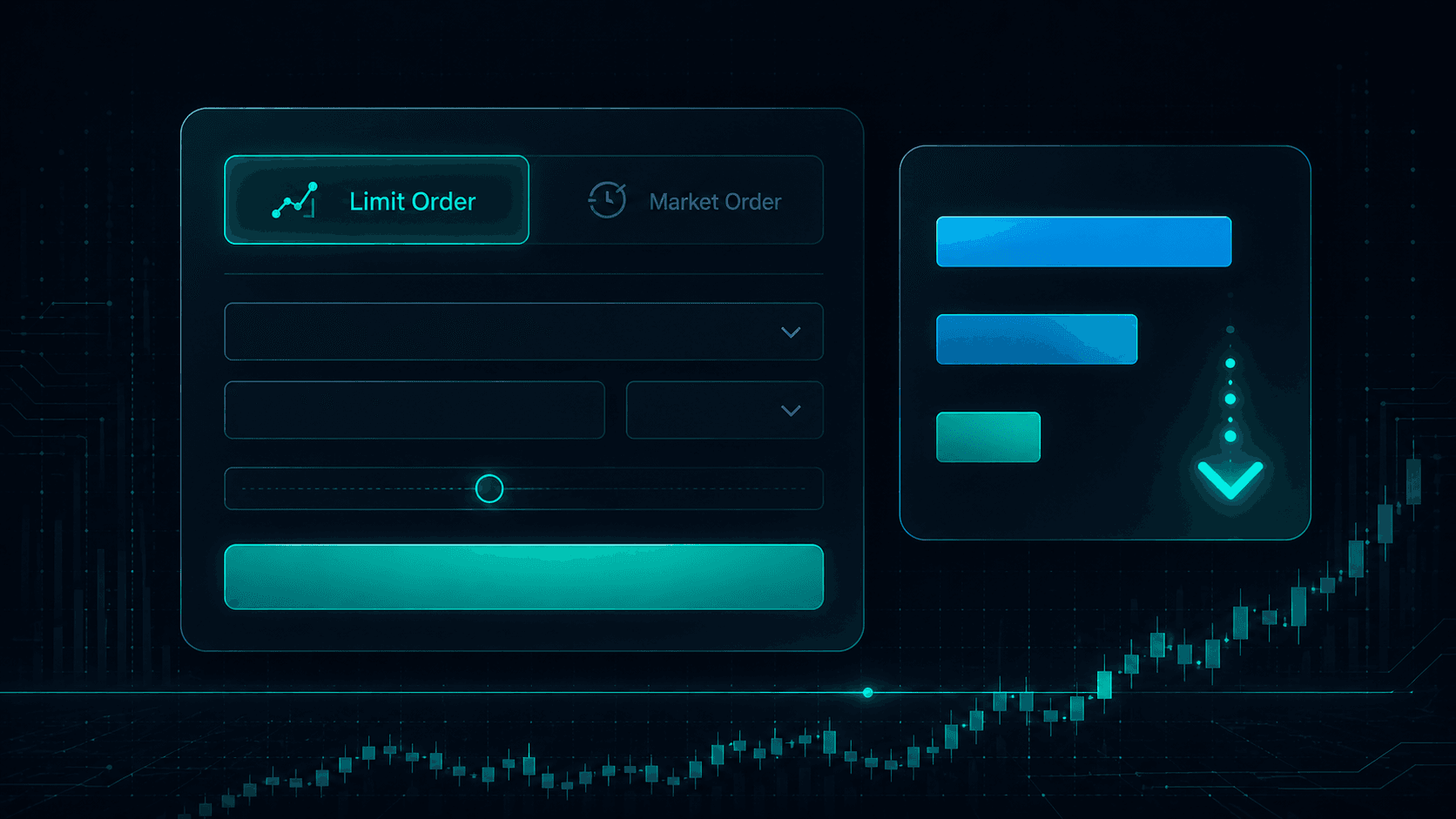
A market with $4,000 in total liquidity and a 6-cent spread is not a market. It is a slow-motion trap. You will pay a fortune to enter, an even bigger fortune to exit, and if news breaks suddenly there will be nobody on the other side of your order.
Most beginners do not even notice. They click "Buy" at the displayed price, watch the fill go through 5 cents above where they expected, and chalk it up to bad luck. It was not bad luck. It was the spread.
How to Avoid It
Before entering any market, check three things:
- Total liquidity. If you cannot get out of a position the same size you got in, the position should not exist.
- The bid-ask spread. A 1-cent spread is healthy. A 5-cent spread means you are losing 5 percent before the market even moves.
- Recent trade volume. No trades in the last 24 hours is a red flag. You are negotiating with a market maker, not a market.
You can browse markets sorted by liquidity and volume directly on the PolyAlertHub Markets page before you decide where to put capital to work.
Rule of thumb: If you would not be comfortable holding the position to resolution, you should not enter it in a market you cannot exit cleanly.
Mistake 3: Chasing Green Candles (a.k.a. FOMO)
A market sits at 38 cents for two weeks. You watch it, think about it, decide it is overpriced, and move on.
Then, in the span of an hour, it jumps to 61 cents on a news headline. Suddenly you are convinced. You buy.
By the time you finish entering your order, the news has already been priced in, the early movers are taking profit, and the price drifts back to 52 cents. You are down 15 percent on a "trade" you spent three seconds thinking about.
This is FOMO, and it is the single most expensive emotion in prediction markets. The reason it works against you is structural: by the time a move is visible enough for you to react to it emotionally, the edge is already gone. You are buying liquidity from the people who positioned before the news broke.
How to Avoid It
The fix is mechanical, not emotional. Decide before the market moves what price you would be willing to pay. Then set an alert at that price and walk away.
This is exactly what the Polymarket Price Alerts feature is designed for. You define the level, get a notification when it hits, and re-evaluate with a clear head instead of chasing a green candle.
If a market has already run 20 cents on news, the correct response is usually to do nothing. The trade you missed is not coming back. Forcing it just turns one missed trade into one bad trade.
Mistake 4: Holding Losing Positions Until Resolution
This one hurts because it feels responsible. You did the research. You took the position. You believe in the thesis. So when the price drops from 55 cents to 30 cents, you "hold" because selling would mean admitting you were wrong.
Here is the problem: in prediction markets, the price is the probability. When a 55-cent outcome trades down to 30 cents, the market is telling you, in dollar terms, that your thesis has gone from a coin flip to a long shot. New information has entered the market, and you are ignoring it.
Holding to resolution is not loyalty. It is refusing to update.
The other half of this mistake is the opportunity cost. Every dollar locked up in a losing position is a dollar that cannot be deployed into a better one. Beginners think of losses as "unrealized" until the market resolves, but the capital is gone the moment the price moves. Pretending otherwise is just accounting fiction.
How to Avoid It
Before you enter any position, define two numbers:
- Your invalidation level. The price at which you admit the thesis is wrong and exit. Write it down.
- Your target. The price at which you take profit. Also write it down.
If you cannot define these two numbers, you do not have a trade plan. You have a hope.
When the invalidation level hits, you sell. No re-analysis, no "let me give it one more day," no averaging down. The plan was set when you were calm. The exit happens when you are not.
If the news genuinely changes and the thesis is still valid at the lower price, you can re-enter. But that is a new trade, with a new plan, made consciously, not a continuation of a position you should have closed.
Mistake 5: Blindly Copying Whales
Once new traders discover that Polymarket is on-chain, they have a predictable revelation: "I will just follow the big wallets."
Then they lose money doing exactly that.
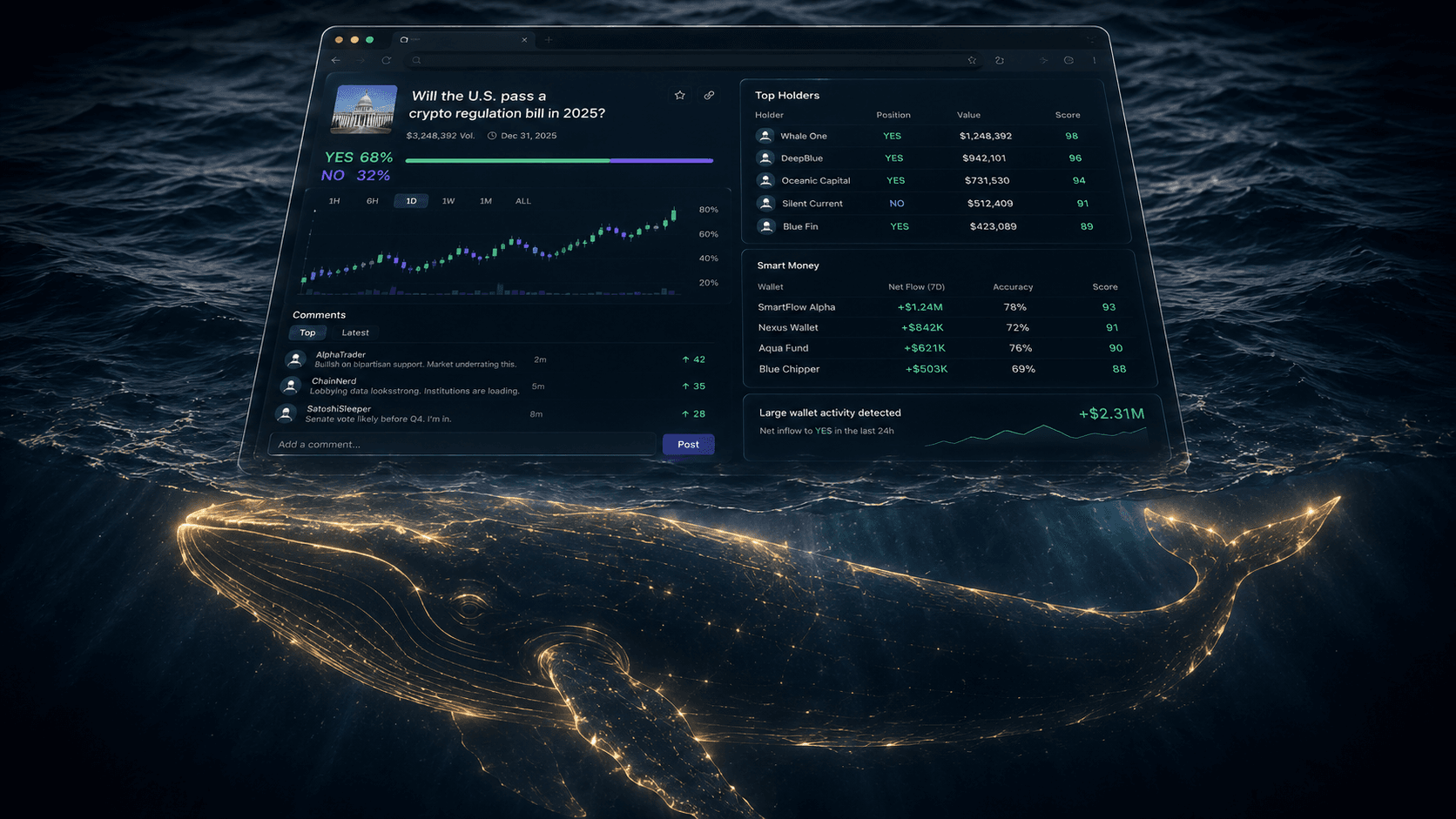
The problem is not that whales are bad signals. It is that "whale" usually just means "wallet with a lot of money," and a lot of money on Polymarket does not automatically mean a lot of skill. Market makers move enormous size with zero directional view. Hedgers buy "No" on outcomes they actually want. Wealthy beginners exist. Wash trading exists. Following raw volume is following noise.
The other failure mode is following a single sharp trader on every single trade. Even the best wallets on Polymarket have losing months. Copy any individual trader on every move and you will copy the losses too.
How to Avoid It
Two principles:
- Filter for skill, not size. Look at realized PnL, win rate on non-trivial prices, and specialization. A trader with $80,000 in profit on political markets is a more useful signal than a trader with $2 million in volume and a flat PnL.
- Wait for consensus. One whale buying "Yes" is interesting. Three independent sharp wallets buying "Yes" in the same window is a signal worth acting on.
The Top Traders Leaderboard lets you sort by profitability rather than volume, and the Whale Convergence feed surfaces the moments when multiple sharp wallets align on the same outcome. That is the kind of input worth building a trade around. A single whale ticker is not.
We covered this in much more depth in How to Spot Smart Money on Polymarket if you want to go further.
If you are reading this list and recognizing yourself in three or four of these, the worst thing you can do is "try harder" with real money tomorrow. Habits do not change because you read a blog post. They change with reps.
This is what Paper Trading is for. You get a $10,000 virtual balance, real Polymarket prices, and zero financial risk. Spend two weeks running your new checklist on simulated trades. Track which mistakes you still make. Fix them in a sandbox where the only thing you lose is a number on a screen.
Traders who skip this step pay tuition to the market. Traders who use it pay tuition to themselves.
Quick Reference: The Anti-Mistake Checklist
Before every trade, ask yourself:
- Edge. Is my probability estimate meaningfully different from the market price, and why?
- Liquidity. Can I exit this position cleanly at a reasonable spread?
- Patience. Am I entering at my pre-decided level, or chasing a move that already happened?
- Exit plan. Do I know exactly what price would make me sell, both up and down?
- Signal quality. If I am following someone else's lead, is it skill-weighted and consensus-confirmed?
Five questions. Thirty seconds. The difference between a year of grinding losses and a year of compounding wins.
Conclusion
Prediction markets are an unusually honest environment. Every mistake you make shows up in your balance, and the market does not negotiate. That sounds harsh, but it is also the reason Polymarket is one of the best teachers a trader can have. There is no hiding from a P&L curve.
The five mistakes in this post are not exotic. They are the default behavior of a new trader operating on intuition. Avoiding them does not require genius. It requires a checklist, a price alert, and the willingness to be wrong in writing before you are wrong with money.
Build the discipline in paper trading. Validate the discipline with small real positions. Scale only after you have a track record you would actually copy yourself.
Resources:
Frequently Asked Questions
What is the biggest mistake new Polymarket traders make?
Trading based on what they want to happen rather than what is likely to happen. Every other mistake (chasing prices, holding losers, blindly copying whales) is downstream of the same underlying problem: not separating personal preference from probability estimation.
How much money should I start with on Polymarket?
Start with paper trading and zero real money. Once you have a documented edge in a simulated environment, begin with an amount you would be genuinely comfortable losing entirely. For most beginners, that means hundreds of dollars, not thousands.
How do I know if a Polymarket market is liquid enough to trade?
Look at three signals: total market liquidity, the bid-ask spread, and recent trade activity. A spread under 2 cents and consistent daily volume usually indicates a market you can enter and exit cleanly. Anything wider, and the spread itself becomes a significant cost.
Should I copy trades from Polymarket whales?
Not blindly. Filter whales by realized profitability rather than raw volume, and wait for consensus where multiple skilled wallets independently take the same position. A single whale trade is interesting. Convergence between several sharp traders is an actual signal.
When should I sell a losing position on Polymarket?
When the price hits the invalidation level you defined before you entered the trade. If you did not define one, define one now and use it going forward. Holding losers to resolution is one of the most expensive habits in prediction markets because it locks up capital that could be working in better trades.
Disclaimer: The content provided in this article and via the PolyAlertHub tools is for informational purposes only. It does not constitute financial, investment, or trading advice. Prediction markets carry high risk, and you should never wager more than you can afford to lose. Past performance does not guarantee future results.