Polymarket Analytics: How to Use Free Tools to Track Winning Traders
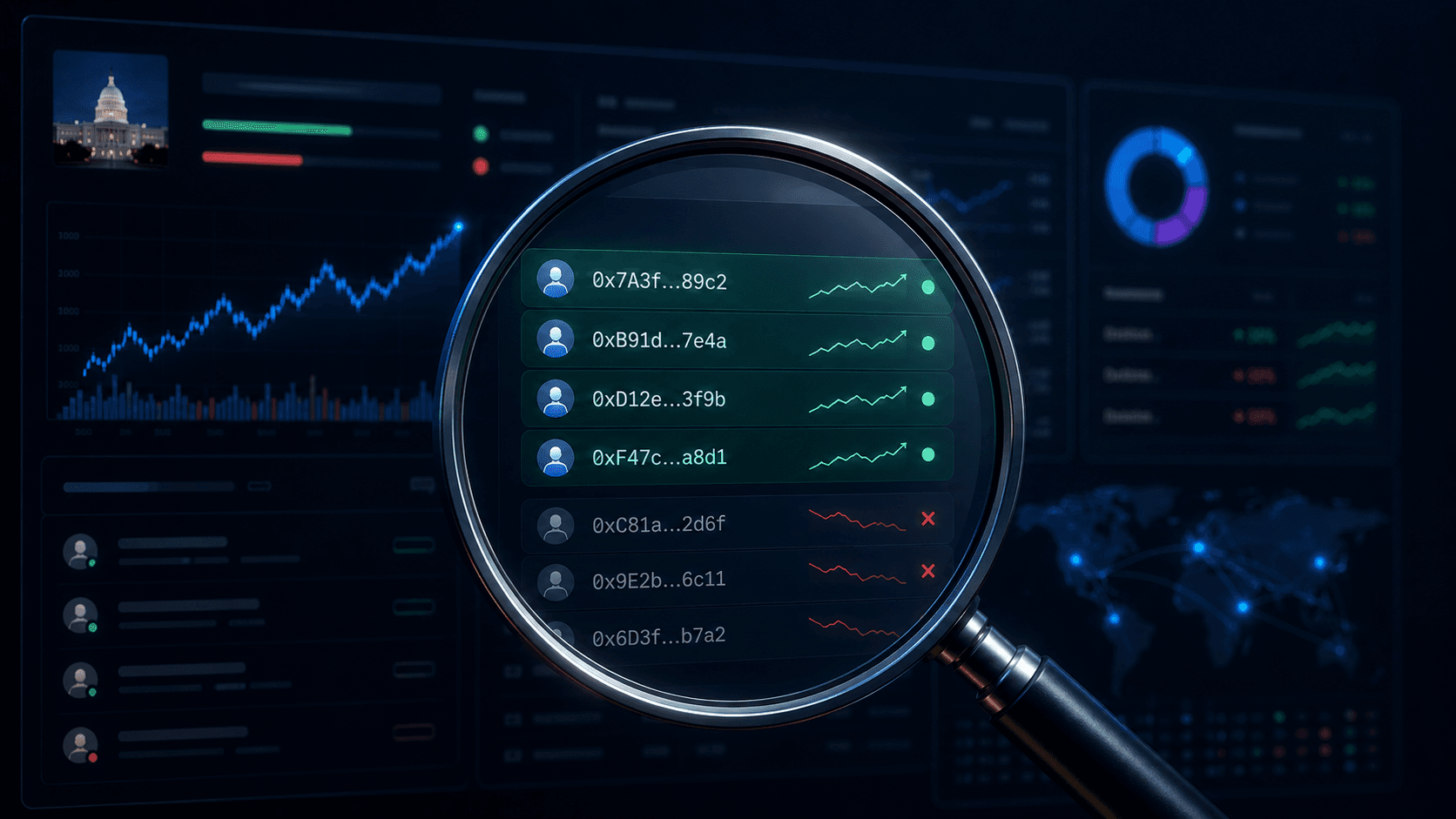
Polymarket is one of the most public markets on the planet. Every position, every fill, every realized profit and loss is on-chain and inspectable. You can look up the exact wallet of a trader who just made $200,000 on an election market, see what else they hold, and watch their next move in real time.
Almost no one actually does this.
Most retail traders are still picking markets based on a tweet, a vibe, or a headline. Meanwhile a small group of consistent winners is leaving a glowing breadcrumb trail of trades you can study for free.
This guide is about closing that gap. We will walk through how to use free Polymarket analytics to find consistently profitable wallets, how to study what they are doing, how to analyze the markets they are in, and how to turn that information into a repeatable workflow without copying anyone blindly.
What You Will Learn
- How to look up any Polymarket wallet's total PnL, win rate, and open positions
- How to filter for traders who are actually skilled vs. lucky
- How to analyze any market for liquidity, flow, and positioning
- How to turn analytics into a watchlist with live Whale Alerts
- The biggest mistakes people make when "following smart money"
Why On-Chain Analytics Are Polymarket's Superpower
In traditional finance, you cannot see the order book of a hedge fund. In sports betting, you cannot see what positions the sharp account at your sportsbook holds. In crypto, you can see wallets but not their intent.
On Polymarket, you can see:
- Every trade a wallet has ever made (entry, exit, size, price).
- Every position it currently holds.
- Realized and unrealized P&L across the entire account history.
- Win rate across resolved markets.
- Concentration (are they spread across 200 markets, or making 3 big bets?).
This is, frankly, an enormous advantage for anyone willing to use it. The information asymmetry that makes most markets hard barely exists here. The asymmetry that does exist is attention: very few people bother to look.
Step 1: Find the Wallets Worth Tracking
The first job of analytics is to filter signal from noise. A wallet up $50,000 on one lucky 50/50 trade is not the same as a wallet up $50,000 across 200 resolved positions over a year. You want the latter.
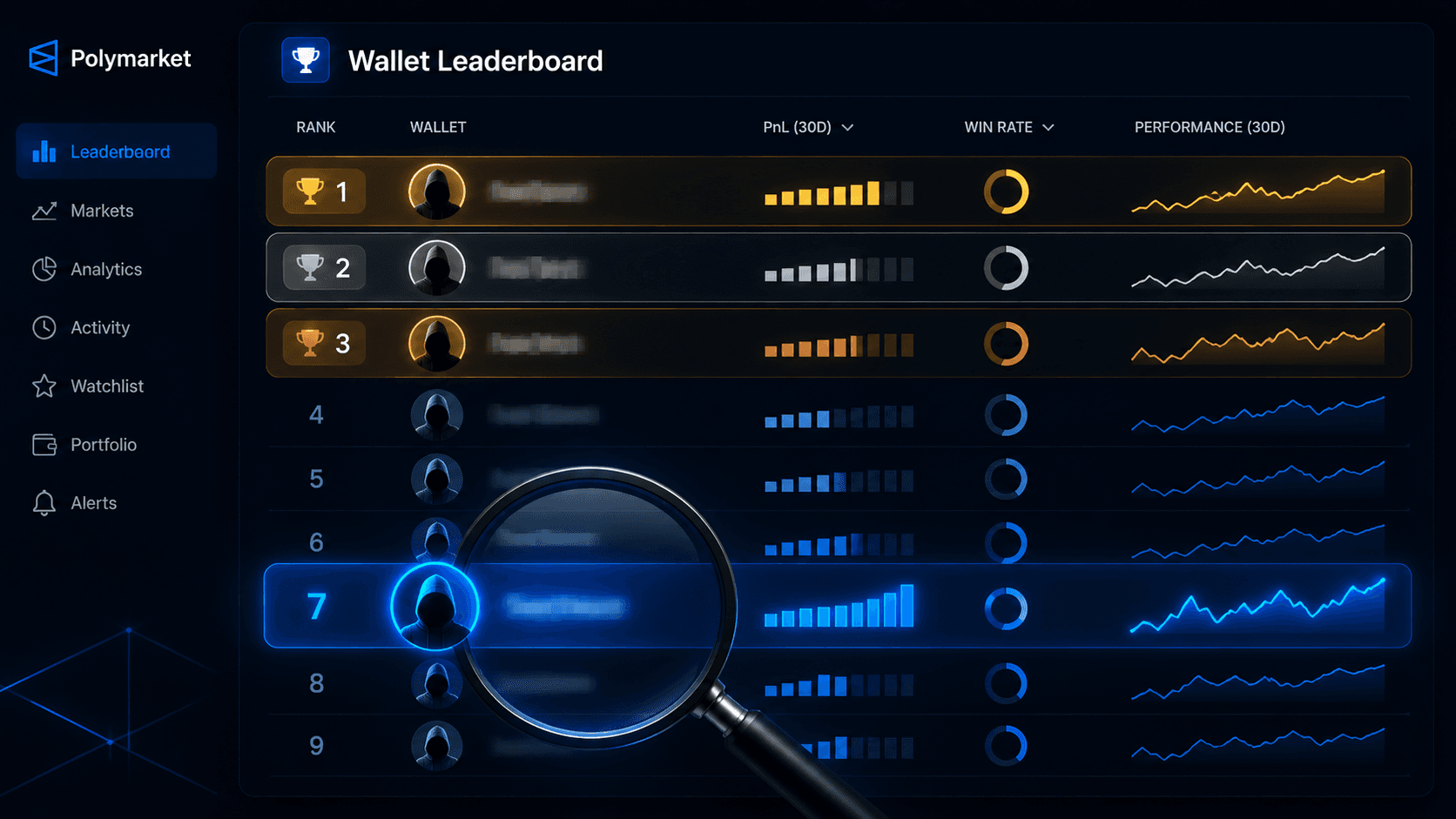
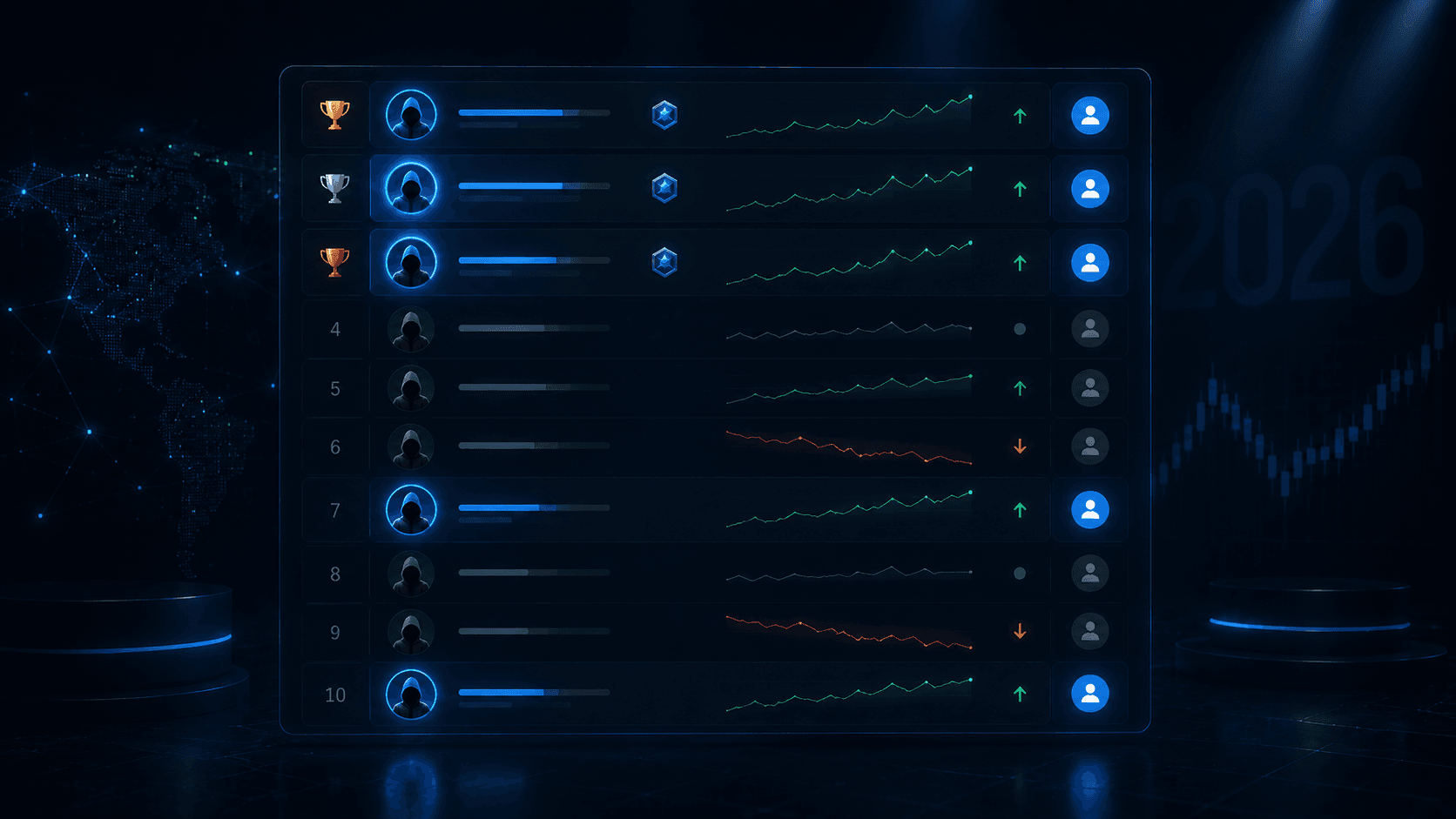
A good starting place is the Traders Leaderboard. It surfaces wallets ranked by realized PnL, with summary stats so you can sort skill from luck at a glance.
Useful filters to apply mentally as you scan:
- Total resolved trades > 50. Below this, "win rate" is mostly noise.
- Win rate above ~55%. On a price-equals-probability market, hitting above 55% across many trades is genuinely hard. Anything 60%+ over hundreds of trades is exceptional.
- PnL not driven by a single trade. Click into the profile, look at the P&L curve. A smooth grind is a different trader than a single moon-shot.
- Activity in markets you understand. A wallet crushing crypto markets you do not follow is less useful to you than a wallet doing well in politics or sports you do follow.
A practical starting point: pick 5 to 10 wallets that pass those filters, in categories you actually understand. That is your watchlist.
Step 2: Read a Trader Profile Like an Analyst
Once you click into a wallet, you are looking for patterns, not just numbers.
Open a profile page at polyalerthub.com/traders/<wallet> and ask:
1. Where do they make money?
Is the PnL concentrated in one category (politics, crypto, sports)? That is their lane. Their edge probably does not transfer to other categories.
2. How do they enter?
Look at fill prices versus the eventual high/low of each market. Are they buying near lows and selling into highs? Are they fading consensus, or piling onto winners? This is style.
3. How long do they hold?
Hold time matters. A trader who scalps the same market five times in a day is a totally different signal than a trader who buys once and holds to resolution.
4. Do they take profits or wait?
Open positions vs. realized PnL tells you a lot. A wallet that consistently closes winners into strength behaves very differently from one that always rides to resolution.
5. Are they early or late?
Cross-reference their entry timestamps against when the market first opened or when the relevant news broke. Early money in liquid markets is usually informed money.
You are not just collecting names. You are building a thesis about each trader: what they are good at, how they trade, and when their flow is worth paying attention to.
Step 3: Analyze the Markets, Not Just the Traders
A trader profile tells you who is good. A market analysis tells you where the next opportunity is.
On any market page (polyalerthub.com/markets/<market-slug>), the things worth looking at are:
- Order book depth and spread. Tight spread + thick book = tradable. Wide spread + thin book = expensive to be wrong.
- Volume over time. A market that suddenly spikes in volume often correlates with a real catalyst or a real opinion change.
- Holder concentration. Are 3 wallets holding 60% of the Yes side? That is concentrated conviction (or concentrated risk).
- Recent large trades. Whales hitting the same side in size within a short window is usually a signal worth investigating.
- Cross-trader overlap. If multiple wallets from your watchlist are on the same side of the same market, that is a coincidence worth your attention.
The combination of "good traders" + "good markets" is where edge actually lives. A great trader buying noise is still noise. A great trader buying a market with real catalysts in front of it is something else entirely.
Step 4: Turn the Watchlist Into Live Alerts
Manually checking 10 wallets twice a day does not scale, and you will miss the moves. This is where alerts matter.
A clean workflow:
- Build your watchlist of 5 to 10 wallets using the steps above.
- Set up Whale Alerts on those wallets, with thresholds that match how they trade. A wallet that normally trades in $20k clips deserves a lower threshold than one that swings $500k.
- Cross-reference with the Whales Live Feed to see clustering. If three of your tracked wallets all hit the same market within an hour, that is a signal, not a coincidence.
- When an alert fires, do not just copy. Open the market, read the situation, decide if your thesis agrees. Then act with a limit order.
This is the single biggest workflow upgrade an active Polymarket trader can make. Most people get information after the move. This setup gets it to you while the move is still happening.
The biggest mistake people make with whale tracking is treating it as a copy-trading service.
It is not. It is a research input.
A whale's trade tells you they have a view. It does not tell you:
- Their time horizon. They might be hedging, scaling out, or playing a multi-week thesis.
- Their size context. A $50k position is small for some wallets, huge for others.
- Their portfolio offset. They may be hedging a much larger position elsewhere you cannot see.
- Their information. They may be wrong. Whales lose all the time, the losses just stand out less because the wins were big.
Use whale flow to find candidates. Then form your own view. Then size based on your conviction, not theirs. This separates traders who get smarter from traders who just become slower copies of someone else.
For a deeper look at this trap, 5 Common Mistakes New Polymarket Traders Make covers blind copy trading directly.
A Sample Weekly Workflow
For a serious retail trader, a sustainable weekly analytics routine might look like this:
Sunday (30 minutes):
- Open the Traders Leaderboard. Re-rank by recent performance.
- Refresh your watchlist: add anyone genuinely interesting, drop wallets that have gone quiet.
- Skim the top markets on Markets Explorer for the week ahead. Note catalysts (elections, sports events, crypto unlocks).
During the week (5 to 10 minutes a day):
- Check fired Whale Alerts. For each, open the market, form a view, take action only if you agree.
- Glance at the Whales Live Feed once or twice a day to spot clustering.
End of week (20 minutes):
- Review your own trades. Where did you act on real signal? Where did you act on FOMO?
- Update your watchlist accordingly.
This is a workflow that fits around a job. Most people skip it and trade reactively. That is why most people are not on the leaderboard.
Conclusion
Polymarket is one of the few markets in the world where the smart money is literally listed by wallet, ranked by PnL, and trackable trade by trade. Using free analytics to study those wallets, understand what they are good at, and follow their flow with alerts is the single highest-leverage upgrade most retail traders can make.
The path is straightforward:
- Find consistently profitable wallets on the Traders Leaderboard.
- Study them like an analyst, not a fan.
- Analyze the markets they are active in.
- Track them with Whale Alerts.
- Use the information as research, not as a copy button.
Do this consistently for a few months and your edge will not come from being smarter than the market. It will come from being plugged into the people who already are.
Resources:
Frequently Asked Questions
Can I see any Polymarket trader's PnL and win rate?
Yes. Polymarket activity is on-chain and inspectable. Tools like the PolyAlertHub Traders Leaderboard and individual trader profile pages surface realized PnL, win rate, position history, and current open positions for any public wallet.
How do I find the best Polymarket traders to follow?
Start with the Traders Leaderboard, then filter for wallets with a large enough sample size (50+ resolved trades), a meaningful win rate, and a smooth PnL curve. Avoid wallets where the PnL comes from a single huge trade, that is luck, not edge.
What is the best way to track a Polymarket whale's activity in real time?
Set Whale Alerts on specific wallets and watch the Whales Live Feed for clustering. Alerts can be delivered via Telegram or email so you do not have to babysit a screen.
Should I copy trades from top Polymarket traders?
Not blindly. Whale flow is a research input, not a copy button. You do not know their time horizon, their offsetting positions, or their conviction. Use their trades to find candidates, then form your own view and size based on your conviction, not theirs.
PolyAlertHub offers a free leaderboard, individual trader profiles, market explorer with order book and flow data, whale trade tracking, whale position tracking, and configurable whale alerts. Together these cover most of what a retail trader needs to research and monitor Polymarket activity.
Disclaimer: The content provided in this article and via the PolyAlertHub tools is for informational purposes only. It does not constitute financial, investment, or trading advice. Past performance of any trader or strategy does not guarantee future results. Prediction markets carry real risk, and you should never wager more than you can afford to lose. Always do your own research before acting on any signal.