Polymarket Fresh Wallets and Market Correlation: The On-Page Signals Most Traders Miss
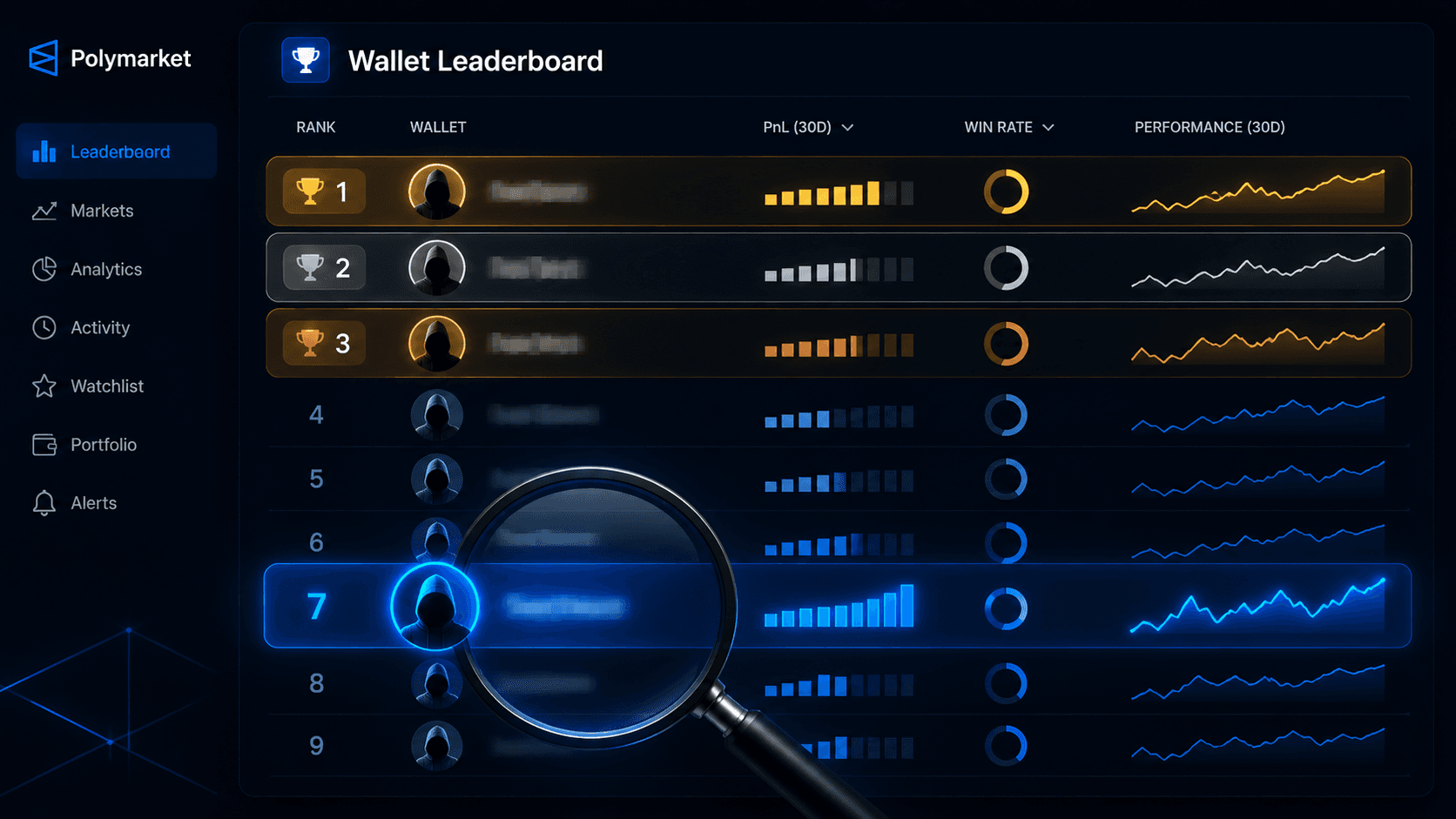
When most people talk about "tracking Polymarket," they mean two things: looking at the whale leaderboard and watching prices. That is a perfectly reasonable starting point, and most traders never get past it.
The two signals that actually move decisions for experienced Polymarket traders are quieter, harder to surface, and almost never read in real time:
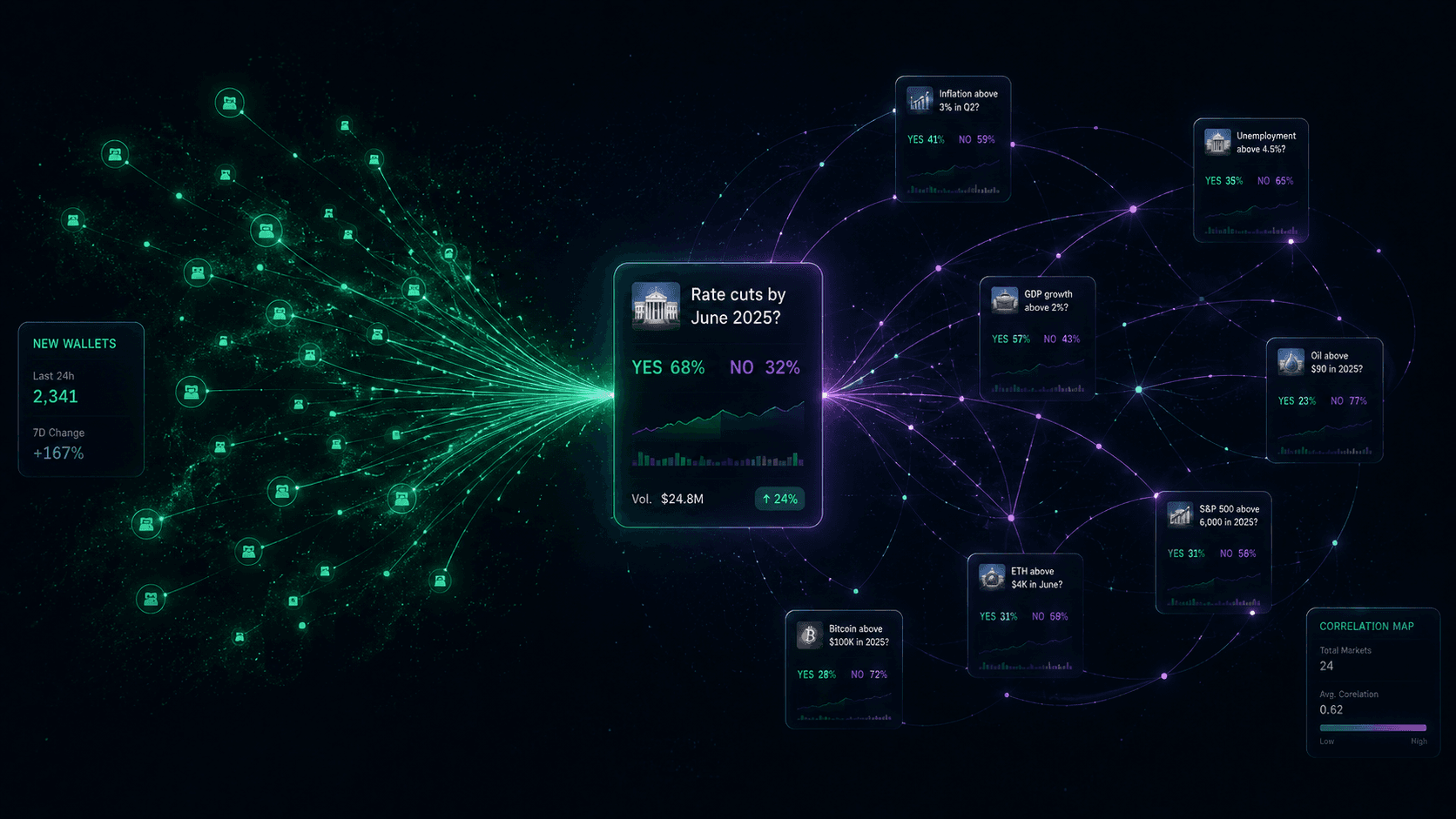
- Fresh wallet activity — newly created addresses building meaningful positions in a specific market.
- Cross-market correlation — other markets whose prices move with the one you are looking at.
Both are quietly priced into outcomes by the people who pay attention to them. Both are now available directly on every polymarket.com/event/... page through the free PolyAlertHub Insights extension, in tabs sitting next to Polymarket's native comments.
This guide is about reading those two signals well.
What You Will Learn
- Why fresh wallets are sometimes the cleanest signal in a prediction market
- How to distinguish a cluster of fresh wallets from background noise
- What correlation actually tells you (and what it does not)
- A simple framework for using both signals together
- The mistakes that turn these signals into noise
Signal One: Fresh Wallets
A fresh wallet is an address that started trading on Polymarket recently. Not all fresh wallets matter. Most are simply new users — Polymarket onboards new accounts every day, and the vast majority of them are retail traders trying out the platform.
What matters is a specific pattern: fresh wallets that show up in one specific market in clustered timing with non-trivial size, especially before a known catalyst.
There are exactly two innocent explanations for clustered fresh wallet activity, and both are rare:
-
A piece of mainstream content drove a wave of new users. A viral tweet, a podcast episode, an article. In this case the fresh wallets are spread across many markets, sized small, and timed around the publication.
-
A new educational platform onboarded users. Same dynamic — broad, small, recent.
When fresh wallet activity is narrow (one market, not many), synchronized (same hour or two), and sized non-trivially (each wallet large enough to suggest deliberate funding), the innocent explanations get harder to defend.
The remaining explanations include:
- A trader with a view setting up positions from clean addresses.
- A trader who wants their entry not to show up in their main wallet's track record.
- Coordinated activity worth understanding before it becomes obvious.
- Insider-style activity tied to information that has not been priced in yet.
You do not need to know which one. You need to know that the pattern is there, on this market, today.
Reminder: "Fresh wallet" is a behavioral signal, not an accusation. Most fresh wallet activity is benign. The cluster pattern is what raises the bar.
How to Read the Fresh Wallets Tab
Open any Polymarket event page with the extension installed. Click the PolyAlertHub logo tab on the right edge. Switch to Fresh Wallets. You will see recently-created addresses that have taken positions in this specific market, ranked by size.
Three questions to ask:
- How many? One fresh wallet is nothing. Five to ten in a tight time window in an otherwise quiet market is something.
- Which side? All on YES, all on NO, or split? Concentration on one side is the strongest version of the signal.
- What size each? Are these $50 positions or $5,000 positions? Funding scale changes interpretation.
For background on the broader dataset behind this tab, see the Polymarket Fresh Wallet Tracker.
Common Mistakes With Fresh Wallets
Mistake 1: Treating any fresh wallet as a signal. Most are not. The cluster pattern is what matters.
Mistake 2: Ignoring market context. Fresh wallets piling into a high-profile, headline-driven market are usually just retail riding the news. Fresh wallets piling into an obscure, low-volume market right before a catalyst are not.
Mistake 3: Not checking the other side. Sometimes there are fresh wallets on both sides — that is two camps, and the signal is much weaker.
Signal Two: Market Correlation
The Correlation tab shows other Polymarket markets whose prices move together with the one you are viewing. It looks like a simple list. It is not.
What Correlation Actually Tells You
There are three reasons two markets can be correlated:
1. Shared underlying narrative.
"Will Candidate X win the primary?" and "Will Party Y win the general?" are correlated because they both depend on the same political environment.
2. Direct logical entailment.
"Will X exceed Y by date Z?" and "Will X be the highest of W, X, Y, Z?" share resolution conditions.
3. Coincidence in the time window.
Two markets happen to have moved together for the last week without any real underlying linkage. This goes away.
Reading correlation well means asking which one this is before trading on it.
Three Useful Things to Do With the Correlation Tab
A. Find a better expression of the same view.
You like the YES thesis on Market A. The Correlation tab shows Market B is 0.9 correlated. Compare:
- Liquidity (which has tighter spreads?)
- Mispricing (does one look richer than the other relative to the shared narrative?)
- Resolution timing (which resolves cleaner?)
If Market B is just a better-priced version of the same view, take Market B.
B. Build a hedged pair.
If two markets are tightly correlated and one is mispriced relative to the other, that is a pair trade — long the cheap side, short the rich side, neutral on the underlying narrative.
C. Detect when correlation breaks.
Two markets that have been moving together for weeks suddenly diverge. Either one of them has new information, or the correlation was always coincidence. Either way, that is worth a closer look.
What Correlation Does Not Tell You
Correlation is descriptive, not predictive. The fact that Market A and Market B have moved together does not promise they will continue to. Use it to find candidates, not to commit to a thesis.
Putting Them Together
The most useful reads come from combining the two signals.
Setup 1: Fresh wallets + correlated market mispriced.
Cluster of fresh wallets enters Market A on YES. The Correlation tab shows Market B is highly correlated with A. Market B has not yet moved. That is a window where Market B may be priced as if A had not moved — exactly the kind of inefficiency that closes once enough people notice.
Setup 2: Smart money disagreement + correlation as confirmation.
The Smart Money tab shows high-scoring wallets on NO. The price action is climbing on YES. The correlated markets are also drifting up. If the correlated markets reverse first, it is a leading indicator that the smart money read is starting to play out.
Setup 3: Fresh wallets without correlation context = treat carefully.
Fresh wallet cluster on a market with no clean correlated peer means you cannot cross-check the signal against any other surface. Size smaller. Or wait.
A Quick Workflow Recap
For active traders using the extension on polymarket.com:
- Top Holders — read the cap table.
- Smart Money — check whether scored wallets are on a side.
- Fresh Wallets — look for clustered, one-sided, recent activity.
- Correlation — find better expressions, hedges, or confirmation.
- Set alerts at stop and target before placing the order.
The first four steps live on the Polymarket page itself, thanks to the PolyAlertHub Insights extension. The fifth lives one tab away in PolyAlertHub.
Final Word
The big, loud signals on Polymarket — volume, headline price moves, what crypto Twitter is loud about — are already priced. The signals that are not yet priced tend to be quieter: a small cluster of fresh wallets in a sleepy market, a correlated peer that has not moved yet, a smart money wallet quietly building a contrarian position.
These are exactly the signals that are easiest to ignore when you are tab-switching. They are exactly the signals an on-page extension is built to surface.
If you have not installed it yet, start with the extension overview. Then come back to this guide once you have it running and walk through a few markets.
The data has always been there. Now it is on the page.