Tracking Smart Money on Polymarket: The 52% Win Rate, 80% ROI System
Most "smart money" tools on Polymarket make the same mistake: they confuse size with skill. A wallet with $1 million in volume gets flagged as smart money regardless of whether that wallet is up or down lifetime. Following a wealthy loser is worse than following no one, because it actively misleads you.
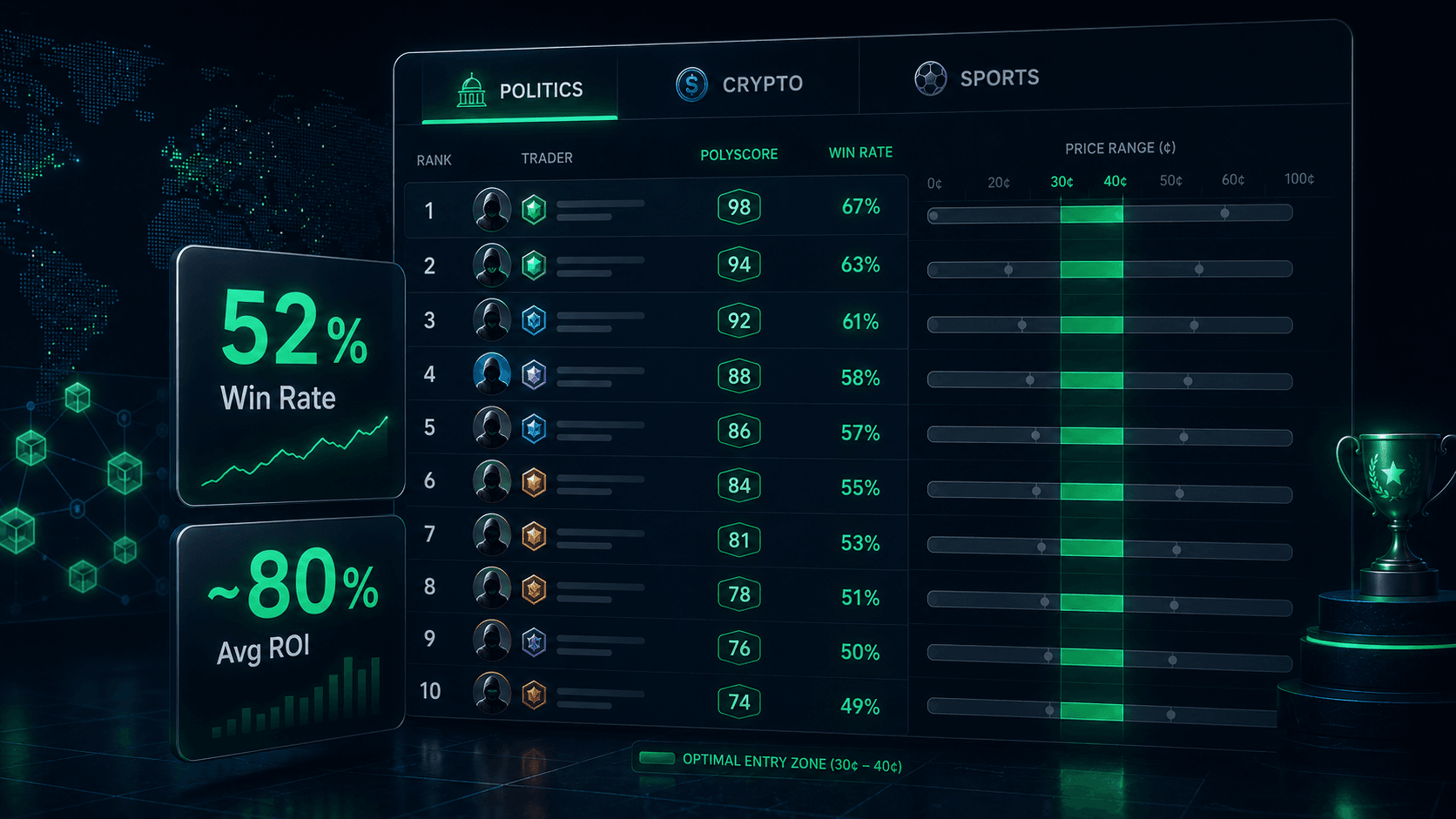
The Smart Money Tracker takes a different approach. It ranks traders by a composite PolyScore built from real performance: realized PnL, ROI, win rate, and the number of markets traded. Then it groups those proven traders by the categories and series they actually specialize in, surfaces the price ranges where they win most often, and lets you alert on their entries. Every alert that fires is tracked to resolution, and the results are published openly on the Smart Money Stats dashboard.
This guide walks through the entire system: how the leaderboard is built, how the alerts work, and what the live performance numbers actually say. As of writing, the alert signals tracked by the system show a 52% win rate with an average ROI of roughly 80% across resolved alerts. We will explain exactly what those numbers mean, what they do not mean, and how to use them responsibly.
What You Will Learn
- How the Smart Money Leaderboard ranks traders by PolyScore and category
- What "optimal price entry ranges" are and why they matter
- How Smart Money Alerts fire and what conviction levels mean
- What the 52% win rate and 80% average ROI on the Stats dashboard actually measure
- How to build a responsible workflow around smart money signals
The Problem: Why Most "Smart Money" Tracking Fails
Before getting into how the system works, it helps to understand what it is correcting.
The default approach to whale tracking on Polymarket is to flag any large position as a signal. This fails for four reasons, which we covered in depth in How to Spot Smart Money on Polymarket:
- Market makers trade huge volume with no directional view. Their size says nothing about conviction.
- Hedgers use prediction markets to offset risk elsewhere. Their positions reflect portfolio construction, not prediction.
- Dumb money with deep pockets exists. A big wallet is not a profitable wallet.
- Wash traders inflate volume to create the illusion of activity.
Any "smart money" signal that starts and ends with position size is indistinguishable from noise. The Smart Money Tracker solves this by making proven performance the entry requirement. Size only matters after skill has been established.
How the Smart Money Leaderboard Is Built
The Smart Money Leaderboard is the foundation of the system. It is not a list of the biggest wallets. It is a list of the most profitable wallets, organized by where their edge actually lives.
The PolyScore
Every trader on the leaderboard is assigned a PolyScore from 0 to 100. The score is a weighted composite of:
- Realized PnL — total profit across resolved positions, with logarithmic scaling so a $10k profit and a $1M profit are not treated as the same shape of result.
- ROI — return on capital, which rewards efficiency, not just absolute dollars.
- Win rate — the percentage of resolved trades that closed in profit.
- Total trades — a sample-size floor that filters out lucky one-hit wallets.
A trader with a high PolyScore has demonstrated profitability across a meaningful sample, not a single jackpot. This is the same distinction we drew in Polymarket Wallet Leaderboard Explained: high PnL and high skill are not the same wallet.
Grouped by Category and Series
This is the part that makes the leaderboard genuinely useful. Instead of one giant ranked list, traders are grouped by the category (tag) or series they trade. A trader who dominates NBA markets shows up under that category. A trader who grinds crypto hourly markets shows up under that series.
Why this matters: skill is contextual. A trader who is excellent in politics may be average in sports. A flat leaderboard hides that. A category-grouped leaderboard surfaces specialists, and specialists are the traders worth following because their edge is verifiable in a specific lane.
Optimal Price Entry Ranges
Each trader row includes the price ranges where they win most often, with the win rate and trade count for each range. This is not a generic "this trader is good" label. It is specific, actionable intelligence: this trader, in this category, enters positions in the 30 to 40 cent range and wins 68% of the time across 142 trades.
That is a categorically different signal from "a big wallet just bought something." It tells you where this trader's edge is concentrated, which lets you filter out alerts that fall outside their proven range.
How Smart Money Alerts Work
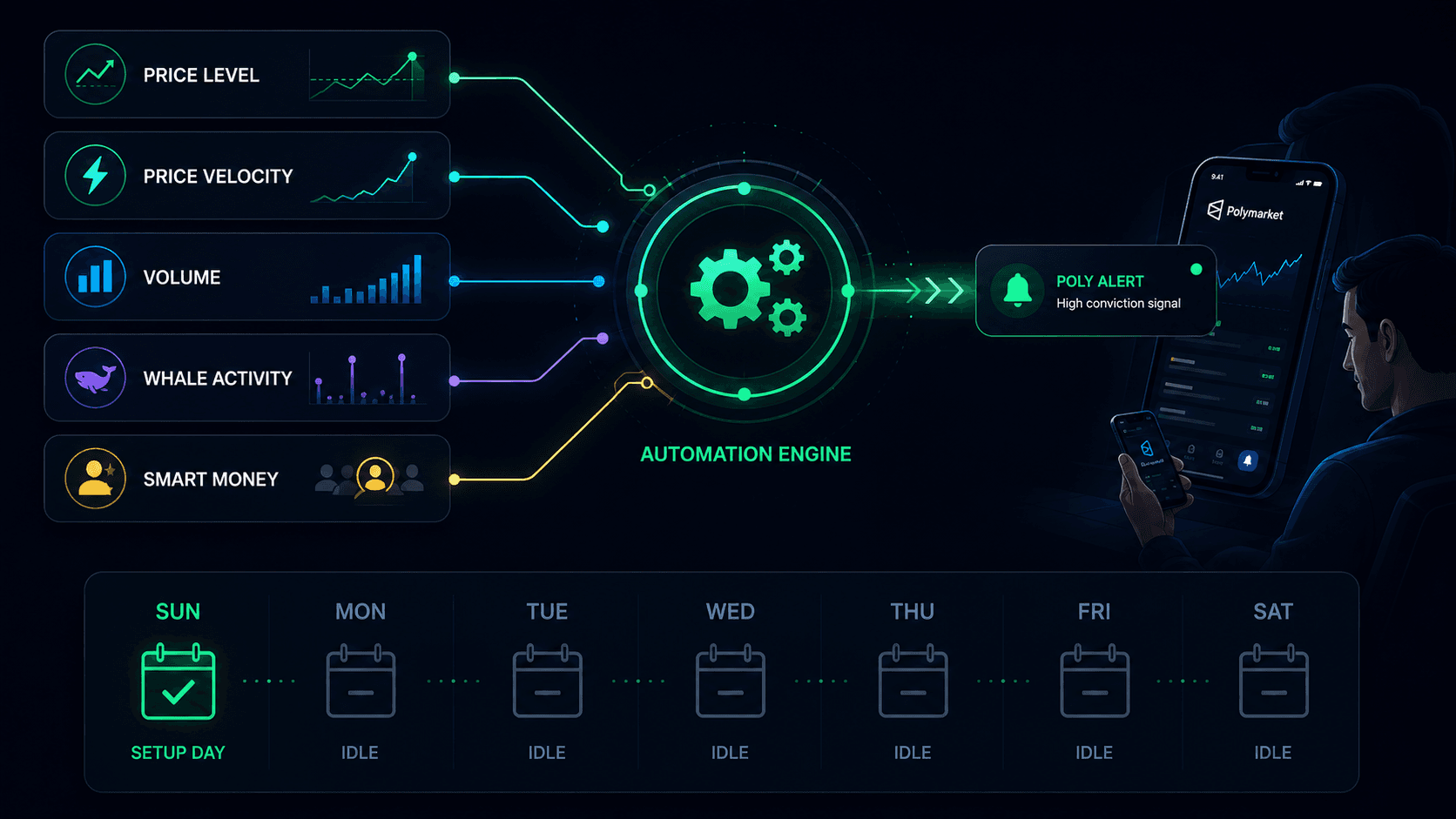
The Smart Money Alerts feature turns the leaderboard into a real-time notification system. Instead of manually checking whether a tracked trader has entered a new position, you configure alerts and get notified the moment a qualifying entry happens.
What Triggers an Alert
An alert fires when a high-PolyScore trader in a category you care about enters a new position that matches their historical edge price range. The combination matters. A great trader entering outside their proven range is a weaker signal than the same trader entering inside it.
You can configure alerts by:
- Category or series — only alert on the lanes you actually trade.
- Conviction level — filter by HIGH, MEDIUM, or LOW conviction. HIGH conviction entries are the strongest signal in the system.
What Conviction Means
Each alert trigger carries a conviction score and level. This reflects how strongly the entry aligns with that trader's historical high-win-rate behavior. A HIGH conviction entry is one where a top trader is entering squarely inside their best historical price range in a category they dominate. A LOW conviction entry is a more marginal match.
The conviction filter is how you control signal density. If you want a quiet feed of only the highest-quality signals, set your minimum conviction to HIGH. If you want broader coverage for research, lower the threshold.
The Numbers: 52% Win Rate, ~80% Average ROI
The Smart Money Stats dashboard tracks every alert signal from trigger to resolution and publishes the aggregate results openly. Here is what the headline numbers mean, and just as importantly, what they do not mean.
Signal Win Rate: ~52%
Of the alert signals that have resolved (excluding pending), roughly 52% have closed as wins. On its own, a 52% win rate sounds modest. But win rate in isolation is a misleading metric, which is why it must be read next to ROI.
A 52% win rate is excellent if the average win is meaningfully larger than the average loss, or if the entries are at prices where a win pays out several multiples of the risk. That is exactly the structure here: smart money entries tend to be at price ranges where a correct call returns a high multiple, because the tracker is surfacing traders who enter in undervalued ranges.
Average ROI: ~80%
The average return across resolved alerts is roughly 80%. This is the number that gives the 52% win rate its meaning. If you win 52% of the time and your average return on resolved trades is 80%, the expected value of each alert signal is strongly positive, even after accounting for the losses.
This is why raw win rate is a trap. A trader who wins 90% of their trades buying 95-cent favorites for 5-cent payouts has a high win rate and a terrible risk-adjusted return. The smart money system inverts this: a moderate win rate paired with a high average ROI because the entries are at prices with real upside.
What the Numbers Do Not Mean
This part matters more than the numbers themselves.
- They are not a guarantee. These are historical aggregate results. Future signals can and will deviate. A 52% win rate means 48% of signals lose. If you cannot tolerate a nearly coin-flip loss rate on any individual signal, this system is not for you.
- They are not a backtest of a trading strategy. They measure the signals the system generated, not the returns a specific user achieved. User returns depend entirely on position sizing, which signals you acted on, and your own entry and exit decisions.
- They are not the same as copy trading returns. Copying a smart money entry at a different price, with different sizing, produces a different result. The stats measure the signal, not your execution.
- Past performance does not guarantee future results. Edges decay. Categories shift. Traders cool off. The numbers are a reason to pay attention, not a reason to bet blindly.
The stats dashboard also breaks performance down by conviction level, by category, and by time window, so you can see whether HIGH conviction signals perform better than LOW (they do), and which categories the edge is currently strongest in. Use these filters before drawing conclusions from the headline number.
A Responsible Smart Money Workflow
The traders who extract the most value from this system do not treat it as an autopilot. They treat it as a high-quality signal source that still requires their judgment. Here is the workflow that works.
Step 1: Pick your categories.
Do not alert on every category. Pick the 2 or 3 you actually understand and would be comfortable holding positions in. Signal quality is higher when you can evaluate the signal.
Step 2: Set conviction to HIGH.
Start with only HIGH conviction alerts. This keeps your feed quiet and your signals at the top of the quality distribution. You can widen later if you want more coverage.
Step 3: Evaluate each alert before acting.
When an alert fires, do not blindly enter. Ask: does this fit my own view? Is the entry price still available, or has the market already moved? Is this a market I want to hold to resolution? The alert is a prompt to look, not an instruction to buy.
Step 4: Size conservatively.
Even with a 52% win rate, any single signal can lose. Risk no more than a small percentage of your bankroll per signal. The edge is in the aggregate, not in any one trade. If you over-size a single signal and it loses, you have defeated the entire point of a system whose value is in its sample.
Step 5: Track your own results against the stats.
The Stats dashboard shows the system's aggregate performance. Your job is to track your own performance on the signals you chose to act on. If your realized results diverge badly from the system's, the issue is almost certainly in your execution (sizing, entry timing, exiting early), not in the signals.
Step 6: Refresh your category focus periodically.
Edges rotate. A category that produced strong signals for three months may quiet down as the traders in it shift focus. Check the stats dashboard's category breakdown and adjust which categories you alert on as the data shifts.
Smart Money vs. Other Alert Types
Smart money alerts are not a replacement for the rest of your alert stack. They serve a specific role. Here is how they fit alongside the others.
- Price alerts tell you when a market hits your level. They are about your plan.
- Price movement alerts tell you when a market moved fast. They are about velocity.
- Volume change alerts tell you when capital is flowing. They are about flow.
- Whale alerts tell you when a large wallet acted. They are about size, attributed.
- Smart money alerts tell you when a proven trader acted in their proven range. They are about skill, attributed.
The key distinction: whale alerts flag any large trader. Smart money alerts flag only traders who have passed a performance filter, and only when they act inside their demonstrated edge. Smart money alerts are the most refined signal in the stack, which is also why they fire less often. Quality over quantity.
For the broader alert philosophy, see Why Professional Traders Use Alerts.
Where to Access the System
- Smart Money Leaderboard — browse top traders by category and series, with PolyScore and optimal price entry ranges.
- Smart Money Alerts — configure notifications for high-conviction entries by proven traders.
- Smart Money Stats — live performance dashboard for all alert signals, including win rate, average ROI, and breakdowns by conviction and category.
- Trader Leaderboards — the broader leaderboard for sourcing and vetting individual wallets.
- Whale Alerts — general large-flow alerts for the rest of your stack.
Conclusion
Smart money tracking on Polymarket is only useful when it is built on proven performance, not position size. The Smart Money Tracker ranks traders by a composite PolyScore, groups them by the categories where their edge actually lives, surfaces the price ranges where they win most often, and lets you alert on their entries. Every signal is tracked to resolution and published openly on the stats dashboard.
The 52% win rate and ~80% average ROI are real and meaningful, but they are a reason to pay attention, not a reason to outsource your judgment. The traders who benefit most from this system are the ones who use it as a high-quality signal source, apply their own evaluation before acting, size conservatively, and track their own results against the aggregate.
Edge in prediction markets comes from better information and better process. Following proven traders, in their proven lanes, at their proven prices, is one of the cleanest forms of better information available. The system gives you the signal. The discipline is still yours.
Resources:
Frequently Asked Questions
What is the Smart Money Tracker on Polymarket?
The Smart Money Tracker is a PolyAlertHub feature that ranks Polymarket traders by a composite PolyScore based on realized PnL, ROI, win rate, and trade count, then groups them by the categories and series they specialize in. It also surfaces the price ranges where each trader wins most often, and lets you set alerts on their entries.
What do the 52% win rate and 80% average ROI numbers mean?
They are the aggregate results of the alert signals tracked by the system, published on the Smart Money Stats dashboard. Roughly 52% of resolved signals have closed as wins, with an average ROI of about 80% across resolved alerts. They describe the historical performance of the signals, not a guaranteed return for any user, since your results depend on which signals you act on and how you size and execute them.
How is a smart money alert different from a whale alert?
A whale alert fires when any large wallet takes a significant position. A smart money alert fires only when a trader who has passed a performance filter (a high PolyScore) enters a position inside their historical high-win-rate price range, in a category they specialize in. Smart money alerts are a more refined signal that attributes the move to proven skill, not just size.
Can I just copy the trades the smart money alerts fire on?
You can act on the signals, but blindly copying is risky. The signals fire at a specific entry price, and by the time you see the alert the market may have moved. Your sizing, your entry price, and your decision to hold to resolution all affect your result. The recommended workflow is to treat each alert as a prompt to evaluate, not an instruction to buy. See the responsible workflow section above.
How often do smart money alerts fire?
That depends on your configuration. If you set conviction to HIGH and narrow to a few categories, the feed will be quiet, only the highest-quality signals. If you widen to more categories and lower the conviction threshold, the feed gets busier. Most serious users start with HIGH conviction on a few categories and widen only if they want more coverage.
On the Smart Money Stats dashboard, which shows win rate, average ROI, totals, and breakdowns by conviction level, category, and time window. Use the filters to evaluate where the edge is currently strongest before drawing conclusions from the headline number.
Disclaimer: The content provided in this article and via the PolyAlertHub tools is for informational purposes only. It does not constitute financial, investment, or trading advice. The 52% win rate and ~80% average ROI figures describe historical aggregate signal performance and do not guarantee future results. Prediction markets carry high risk, and you should never wager more than you can afford to lose. Past performance does not guarantee future results.