Polymarket Volume Change Alerts: Catch the Flow Before the Price
Price tells you where the market is. Volume tells you where the market is going.
This is the single most underrated idea on Polymarket. Almost every retail trader watches price. Almost none of them watch volume. Yet volume is the leading indicator, because volume means capital is being deployed by people who decided to act. Price is the result of that capital flowing. By the time price has moved obviously, the volume that caused it has already happened.
A volume change alert is how you catch that flow as it happens, before the price move is obvious. You define a percentage surge in trading activity within a time window, set a scope, and walk away. When volume explodes on a market you care about, you are notified, often before the corresponding price move is fully visible. This guide walks through exactly how volume change alerts work, why volume leads price, and how to use them as a leading indicator in your trading process.
What You Will Learn
- Why volume is a leading indicator and price is a lagging one
- How volume change alerts measure the rate of change in trading activity
- The built-in presets (Volume Spike, Major Surge, Big Swing) and when to use each
- How the minimum absolute volume filter separates real flow from noise
- How to combine volume alerts with price movement and whale alerts for high-conviction signals
Why Volume Leads Price
To understand why volume change alerts are useful, you have to understand the relationship between volume and price on Polymarket.
When someone decides a market is mispriced, they do not whisper it. They deploy capital. They buy shares. That buying is volume. The price only moves once enough capital has been deployed to exhaust the existing sell-side liquidity. On a thin market, a single large buyer can move the price immediately. On a deeper market, volume can spike significantly before the price responds visibly, because the order book absorbs the initial flow.
That gap, between volume spiking and price moving, is the window where a volume change alert gives you an edge. If you only watch price, you see the move after it has happened. If you watch volume, you see the capital arriving before the price has fully reflected it.
A few concrete patterns:
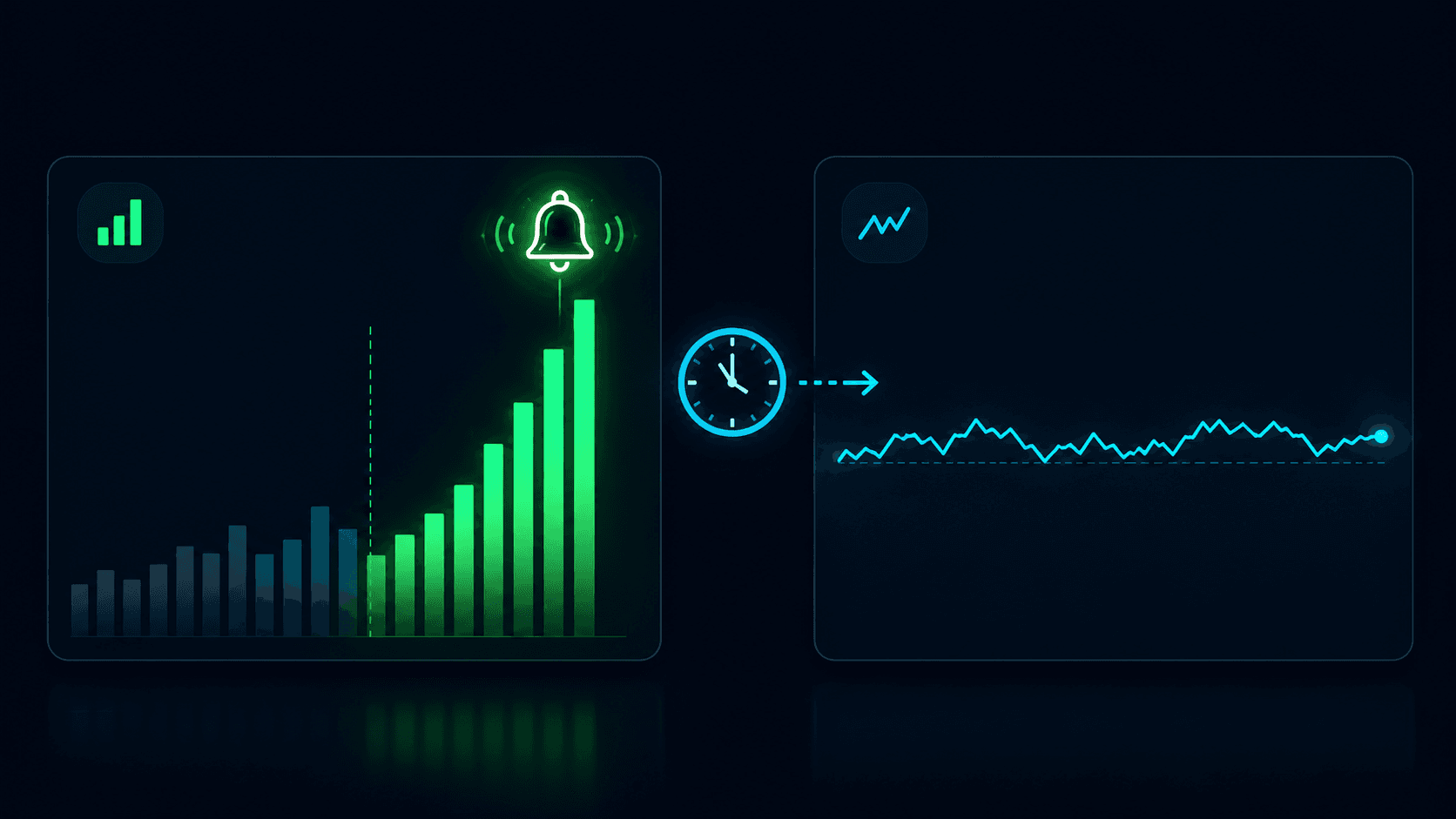
Volume spike, price barely moves. This often means accumulation is happening quietly. A buyer is working into a position slowly, taking what the order book offers without pushing the price. This is one of the most interesting signals a volume alert can surface, because it suggests someone with conviction is positioning before a larger repricing.
Volume spike, price moves with it. The repricing is already underway. The capital flowing in is large enough to push the price. You are not early, but you are not late either, and the volume confirms the move has real conviction behind it rather than being a thin-market fakeout.
Price moves, volume does not. This is a warning sign. A price move on low volume is more likely to be noise, a single small order on a thin book, or a transient fluctuation. Without volume, the move lacks conviction and is more likely to revert.
The traders who consistently catch moves early are the ones who treat volume as the primary signal and price as the confirmation. Volume change alerts are how you do that without watching volume bars on a hundred markets.
How Volume Change Alerts Work
A volume change alert is defined by three core parameters: a percentage, a time window, and an optional minimum absolute volume change. The alert fires when trading activity in a market increases by at least the configured percentage within the configured time window, subject to the absolute change floor.
This mirrors the structure of a price movement alert, but the underlying metric is volume, not price.
Time Windows
The same five lookback windows are available:
- 5 minutes — catches the most sudden bursts of activity. Noisiest.
- 15 minutes — a good balance for detecting sharp intraday flow.
- 1 hour — catches meaningful shifts in activity over a session.
- 6 hours — for sustained surges that develop over several hours.
- 24 hours — for detecting large structural shifts in interest over a full day.
Volume tends to be smoother than price over short windows, so a 1-hour window is the most popular default for volume alerts. It catches real surges without firing on the natural ebb and flow of trading activity.
Percentage Thresholds
Because volume is measured as a rate of change rather than an absolute level, the percentages are larger than for price. A 50% volume increase is a modest surge. A 200% increase is a major event. Common thresholds:
- 50% — a meaningful uptick in activity.
- 100% — volume has doubled. Real surge.
- 200% — volume has tripled. Major event, almost always worth attention.
Minimum Absolute Volume Change
This is the filter that makes volume alerts genuinely useful, and it is the setting most traders overlook.
A 100% volume increase on a market that usually does $500 an hour means volume went from $500 to $1,000. That is technically a doubling, but it is still trivial in absolute terms. A 100% increase on a market that usually does $50,000 an hour means volume went from $50,000 to $100,000. That is a real surge of meaningful capital.
The minimum absolute volume change setting lets you require that the surge be large enough in dollar terms to matter. Setting a floor of $1,000 or $5,000 ensures you are only notified when the volume spike represents real capital flowing in, not when a thin market doubled from nothing to almost nothing.
This single filter is what separates a useful volume alert feed from a noisy one. Always set a minimum absolute change that is meaningful for the categories you trade.
Built-in Presets
PolyAlertHub ships with three volume-specific presets that bundle a percentage, a time window, and a cooldown.
| Preset | What It Catches | Window | Surge | Cooldown |
|---|
| Volume Spike | 50%+ surge in activity | 1h | 50% | 60 min |
| Major Surge | 100%+ increase in activity | 6h | 100% | 120 min |
| Big Swing | 200%+ change in activity | 24h | 200% | 180 min |
When to use each:
- Volume Spike is the day-to-day workhorse. Use it on the categories you actively trade to catch sudden interest during a session. Pair it with a meaningful minimum absolute change so it does not fire on thin markets.
- Major Surge is for detecting sustained waves of capital entering a market over several hours. These often accompany developing news stories or the slow realization of an outcome becoming more likely.
- Big Swing is the structural-shift detector. It fires rarely, but when it does, the market has fundamentally changed character. Use it on categories you want to monitor broadly for regime changes, even when you are not actively trading them.
You can also build fully custom rules. If a category you trade has a known volume profile, tune the percentage and window to that profile rather than relying on the defaults.
Scope and Cooldown
Volume change alerts share the same scope and cooldown model as price movement alerts, which keeps the alert stack consistent.
Scope
- All Markets — watches every eligible market. Pair with a high percentage and a high minimum absolute change, or the feed will be overwhelming.
- Specific Categories — watches only the categories you choose. The recommended scope for most traders.
- Exclude Categories — watches everything except categories you want to ignore.
- My Portfolio — watches only markets you hold positions in. Useful for detecting sudden interest in markets you are already in, which may signal an approaching repricing.
- PolyAlertHub Trading Wallet — watches markets tied to your PolyAlertHub trading wallet. Available without an Advanced plan.
Important note: Like price movement alerts, volume change alerts do not monitor short-term markets (5m, 15m, 1h, 4h resolution) or markets with volume under $50k. This filter ensures the alert only fires on markets where a volume change is likely to be meaningful.
Cooldown
The cooldown prevents the same alert from firing repeatedly while a volume surge is ongoing. After the alert fires, it goes quiet for the cooldown period, then re-arms. The presets already bundle sensible cooldowns, so if you are using a preset you do not need to tune this manually.
A Real Example: Catching Accumulation
Let's make this concrete with the pattern that volume alerts are uniquely good at catching: quiet accumulation before a repricing.
Suppose you follow crypto prediction markets. A market on whether Bitcoin will close above a key level this week has been quiet for two days, trading around 45¢ on low volume. You have no strong view on the outcome, but you want to know if smart capital starts positioning.
Your configuration:
| Setting | Value |
|---|
| Scope | Specific Category: Crypto |
| Preset | Volume Spike |
| Window | 1 hour |
| Surge | 50% |
| Min Absolute Change | $5,000 |
| Cooldown | 60 minutes |
What happens: On Wednesday afternoon, your alert fires. Volume in the last hour is up 80%, with an absolute increase of $12,000. The price, however, has barely moved, from 45¢ to 46¢. This is the classic accumulation signature: capital is arriving, but the order book is absorbing it without a visible price move.
You pull up the market. You check for corroborating signals. A whale alert confirms a large wallet has been buying. The smart money tracker shows a high-PolyScore trader in crypto markets just entered. You have a cluster: volume, whale, and smart money all firing on the same quiet market.
You decide to enter a small position at 46¢. Over the next six hours, the accumulation completes and the price begins to move, closing the week at 72¢. You caught the move before the price made it obvious, because you were watching volume, not price.
This is the scenario that volume change alerts exist for. No price-based alert would have fired, because the price had not moved meaningfully. The volume signal arrived first.
Combining Volume Alerts With Other Signals
Volume change alerts are most powerful as part of a cluster. A volume spike on its own tells you capital is flowing. The other alert types tell you what kind of capital and what it implies.
Volume + price movement: The most fundamental combination. Volume surging without much price movement suggests accumulation (see the example above). Volume surging with price movement means the repricing is underway with conviction. A price move without volume is lower conviction and more likely to revert.
Volume + whale alert: A volume spike followed by a whale alert tells you the flow is attributable to a specific large trader. This turns an anonymous surge into named intelligence, and lets you check that trader's track record before acting.
Volume + smart money alert: The most refined combination. A volume spike followed by a smart money alert from a high-PolyScore trader entering in their proven price range is a high-conviction cluster. The volume told you capital was flowing; the smart money alert told you the capital was skilled. See Tracking Smart Money on Polymarket for that system.
The general principle, the same one we describe in Why Professional Traders Use Alerts: a single alert is a reason to look. A cluster of alerts on the same market is a reason to act.
Common Mistakes With Volume Change Alerts
Skipping the minimum absolute change. This is the number one mistake. Without an absolute floor, a 100% alert fires on markets that doubled from $200 to $400 in volume, which is meaningless. Always set a minimum absolute change that is meaningful for your categories.
Using too short a window. Volume is naturally spiky over very short windows. A 5-minute volume window will fire constantly on active markets. For volume specifically, 1-hour and 6-hour windows are usually more useful than 5-minute windows.
Watching all markets with a low threshold. The platform has thousands of markets. A 50% volume alert on All Markets with no absolute floor will generate an unmanageable feed. Narrow your scope, raise your threshold, or set a meaningful absolute floor, ideally all three.
Treating volume as a directional signal. Volume tells you that capital is flowing, not which way the market will go. A volume spike can precede a move in either direction. Always confirm direction with price movement, whale alerts, or smart money alerts before acting.
Ignoring the quiet accumulation pattern. The most valuable volume signal is the one where volume spikes and price does not move. Many traders dismiss these because there is no obvious price action. That is exactly the pattern to pay attention to, because it is where the edge lives.
Conclusion
Volume is the leading indicator that most Polymarket traders ignore. Price tells you where the market is; volume tells you where capital is taking it. By the time the price move is obvious, the volume that caused it has already happened, and the early edge is gone.
Volume change alerts let you catch that flow as it happens. You define a percentage surge, a time window, and a minimum absolute change, and the system notifies you the moment real capital starts flowing into a market. Used on their own, they tell you something is happening. Combined with price movement, whale, and smart money alerts, they form the core of a monitoring system that catches moves before they are obvious.
Stop watching price alone. Start watching the flow that moves it.
Resources:
Frequently Asked Questions
What is a Polymarket volume change alert?
A volume change alert is a velocity-based notification that fires when a market's trading activity increases by at least a configured percentage within a configured time window, subject to an optional minimum absolute volume change. For example, "alert me when volume surges 50% within 1 hour, with at least $5,000 in new activity." It catches capital flowing into a market, often before the corresponding price move is fully visible.
Why use volume alerts instead of just watching price?
Because volume often leads price. When capital flows into a market, volume spikes before the price fully reflects it, especially on deeper markets where the order book absorbs initial flow. A volume alert can notify you of accumulation happening quietly, before any price-based alert would fire. Price tells you where the market is; volume tells you where capital is taking it.
What is the minimum absolute volume change and why does it matter?
It is a dollar floor on the volume surge. Without it, a 100% alert fires on markets that doubled from trivial volume to slightly less trivial volume, which is meaningless. Setting a floor like $1,000 or $5,000 ensures you are only notified when the surge represents real capital flowing in, not noise on thin markets.
Does the volume change alert monitor every market?
No. Like price movement alerts, volume change alerts do not monitor short-term markets (5m, 15m, 1h, 4h resolution) or markets with volume under $50k, since volume changes in those markets are typically noise. You control which remaining markets are watched via the scope settings: All Markets, Specific Categories, Exclude Categories, My Portfolio, or your PolyAlertHub trading wallet.
What volume presets are available?
Three presets are built in: Volume Spike (50%+ surge in 1 hour), Major Surge (100%+ increase in 6 hours), and Big Swing (200%+ change in 24 hours). Each bundles a sensible cooldown. You can also build fully custom rules tuned to a specific category's volume profile.
Should I combine volume alerts with other alert types?
Yes. Volume tells you capital is flowing, but not which way the market will go or who is behind the flow. The highest-conviction signals come from clusters: a volume spike plus a price movement alert plus a whale or smart money alert on the same market. A volume spike with no price move often signals quiet accumulation, one of the most valuable patterns a volume alert can surface. See Why Professional Traders Use Alerts for the full alert stack.
Disclaimer: The content provided in this article and via the PolyAlertHub tools is for informational purposes only. It does not constitute financial, investment, or trading advice. Prediction markets carry high risk, and you should never wager more than you can afford to lose. Past performance does not guarantee future results.