Understanding Polymarket Odds: How a 60¢ Share Actually Works
The first time you open Polymarket, the prices look strange.
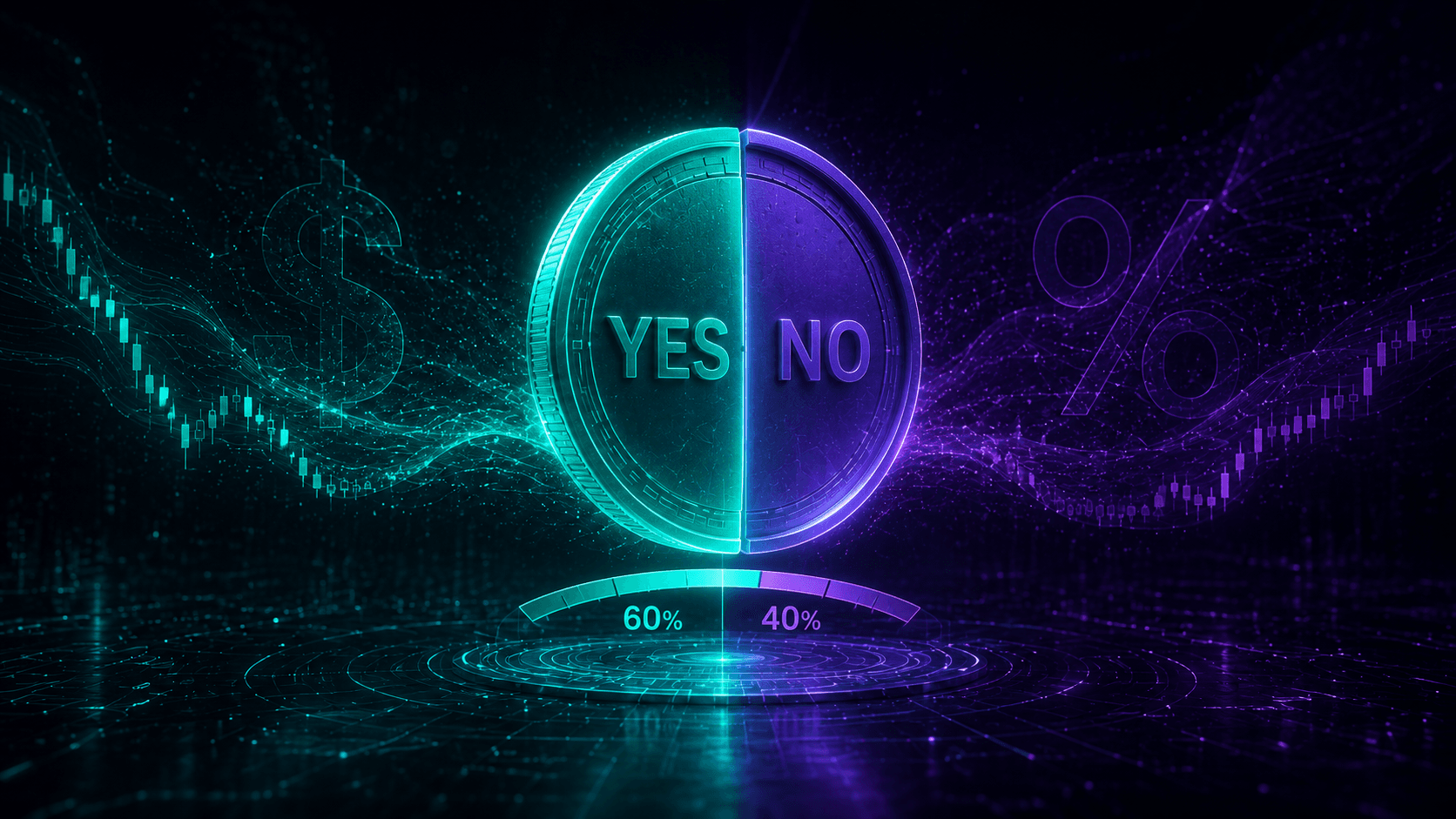
A market about an election shows "Yes: 60¢ / No: 40¢." Another about a Fed decision sits at "Yes: 12¢ / No: 88¢." There are no decimal odds, no fractions, no plus and minus numbers like a sportsbook. Just two prices that always seem to add up to roughly a dollar.
That is not a coincidence and it is not arbitrary. Polymarket prices are not really "prices" in the traditional sense. They are probabilities wearing a dollar sign, and once you see them that way, everything about how the platform works clicks into place.
This guide is the simplest possible explanation of what a Polymarket share actually is, what 60¢ really means, and exactly how much money lands in your account when a market resolves.
What You Will Learn
- Why every Polymarket price is a probability between 0 and 1
- What you are actually buying when you click "Buy Yes" at 60¢
- The exact dollar amount you win (and lose) when a market resolves
- How Yes and No prices always add up to about $1
- A quick mental model for spotting good and bad prices
Polymarket Prices Are Probabilities
Every market on Polymarket has two possible outcomes: Yes or No. Each one trades as a share with a price somewhere between $0.00 and $1.00.
Here is the only rule you really need to remember:
The price of a share is the probability the market thinks that outcome will happen.
- A share trading at $0.60 means the market believes there is a 60% chance that outcome happens.
- A share trading at $0.05 means the market believes there is a 5% chance that outcome happens.
- A share trading at $0.50 is a coin flip in the eyes of the market.
That is it. There is no other math hiding underneath. If you can read a percentage, you can read a Polymarket price.
What You Are Actually Buying
When you buy a Yes share at 60¢, you are buying a contract that pays out exactly $1.00 if Yes wins, and $0.00 if Yes loses.
Same logic for No shares. A No share at 40¢ pays $1.00 if No wins, $0.00 if No loses.
So your trade is really very simple:
- Cost to enter: the current share price
- Payout if right: $1.00 per share
- Payout if wrong: $0.00 per share
Everything else (profit, loss, ROI) is just arithmetic on top of those three numbers.
How Much Do You Actually Win?
Let us walk through a concrete example.
You buy 100 Yes shares at $0.60 in a market titled "Will Candidate A win the election?"
- You pay: 100 × $0.60 = $60
- If Yes wins: 100 × $1.00 = $100 back → profit of $40
- If Yes loses: 100 × $0.00 = $0 back → loss of $60
That is the entire trade. You risked $60 to win $40. In percentage terms, you risked 100% of your stake to gain about 67%.
Now compare that to buying at a different price. Suppose you found the same market when Yes was trading at $0.30:
- You pay: 100 × $0.30 = $30
- If Yes wins: 100 × $1.00 = $100 back → profit of $70
- If Yes loses: $30 loss
Same outcome, very different trade. The lower the price you pay, the more upside per dollar you risk. This is why price matters more than direction in prediction markets. Being right at a bad price can still be a losing trade over time. Being right at a good price compounds.
Why Yes + No Always Equals About $1
If Yes is trading at 60¢ and No is trading at 40¢, the two prices add to exactly $1.00. This is not a quirk. It is mathematically necessary.
The market is pricing probabilities, and the probability of Yes plus the probability of No has to equal 100%. One of the two outcomes must happen. So the prices on a healthy Polymarket market always sum to roughly a dollar (give or take a small spread for liquidity).
This also unlocks a useful trick. If Yes is at 60¢ and No is at 38¢, the prices add to 98¢, which means someone could theoretically buy both sides for 98¢ and be guaranteed to get $1.00 back. That tiny 2¢ gap is called intra-market arbitrage, and it disappears almost instantly when it appears. (We cover this in more depth in our Top Polymarket Trading Strategies for 2026 guide.)
For your purposes as a beginner, the takeaway is simpler: if Yes goes up, No goes down by almost the same amount. They are two sides of the same coin.
Reading a Price Like a Pro
Once prices click as probabilities, you can start asking the only question that actually matters at the trade level:
"Do I think the real probability is higher or lower than what the market is showing?"
If the market shows 60¢ and you genuinely believe it is closer to 75%, buying Yes is a positive expected value trade. You are paying 60¢ for something you think is worth 75¢.
If the market shows 60¢ and you think the real probability is 40%, buying Yes is a bad trade no matter how much you "feel" Yes will win. The price is already higher than the truth.
This is the single biggest mindset shift between gambling and trading on Polymarket. You are not betting on what will happen. You are betting that the price is wrong.
For more on that mistake, see 5 Common Mistakes New Polymarket Traders Make.
Quick Reference Table
| Buy Price | Implied Probability | Profit Per Share If Right | Loss Per Share If Wrong |
|---|
| $0.10 | 10% | $0.90 | $0.10 |
| $0.25 | 25% | $0.75 | $0.25 |
| $0.50 | 50% | $0.50 | $0.50 |
| $0.75 | 75% | $0.25 | $0.75 |
| $0.90 | 90% | $0.10 | $0.90 |
Notice the pattern: cheaper shares have more upside but lower probability. Expensive shares are more likely to win but pay almost nothing when they do. There is no free lunch. The market prices the risk into the share.
Practice Before You Pay
Reading prices as probabilities is one of those things that only really sinks in when you do it. The fastest way to internalize it without spending real money is to open a Paper Trading account with $10,000 in virtual balance, click around a few markets, and watch how the prices move as events develop.
You will be surprised how quickly 60¢ stops looking like a price tag and starts looking like a probability.
Conclusion
Polymarket odds look intimidating for about ten minutes. After that, they are easier to read than almost any other betting interface, because every number on the screen is already a probability.
Three things to take with you:
- The price is the probability. A 60¢ share means a 60% chance.
- Every winning share pays exactly $1.00. Your profit is $1 minus the price you paid.
- Yes + No always equals about $1. They are two sides of the same outcome.
Once those three ideas are second nature, you are no longer "betting" on Polymarket. You are doing what every serious trader does: comparing the market's number to your own number, and only acting when the gap is big enough to be worth the risk.
Resources:
Frequently Asked Questions
What does a 60¢ share mean on Polymarket?
A 60¢ share means the market estimates a 60% probability of that outcome happening. If the outcome happens, the share pays out $1.00. If it does not, the share pays $0.00.
How much money do I make if I buy a Polymarket share at 60¢?
You make $0.40 per share if you are right (the $1.00 payout minus the $0.60 you paid), and you lose the full $0.60 per share if you are wrong.
Why do Yes and No prices always add up to $1?
Because one of the two outcomes must happen. The probability of Yes plus the probability of No has to equal 100%, so the prices have to sum to about $1.00. Small deviations exist due to spread and short-lived arbitrage opportunities.
Are Polymarket odds the same as sportsbook odds?
No. Sportsbooks use decimal, fractional, or American odds that bake in a house margin. Polymarket prices are direct probabilities between 0 and 1, set by traders rather than a bookmaker, with no built-in vig beyond a small bid-ask spread.
Where can I practice trading Polymarket odds without losing money?
PolyAlertHub offers Paper Trading with a $10,000 virtual balance and real Polymarket prices, so you can practice reading and reacting to prices risk-free.
Disclaimer: The content provided in this article and via the PolyAlertHub tools is for informational purposes only. It does not constitute financial, investment, or trading advice. Prediction markets carry high risk, and you should never wager more than you can afford to lose. Past performance does not guarantee future results.