How to Analyze Whale Trades Like a Pro
A whale alert hits your phone. A wallet you follow just bought $80,000 of "Yes" on a market you have barely looked at.
Most traders react one of two ways. Either they panic-buy at the first available price and feel clever for "front-running retail," or they freeze, do nothing, and watch the market run while they look up the whale's history.
Both reactions miss the point. The alert is not the trade. The alert is the prompt to start analysis. Pros treat whale activity the same way a research analyst treats an earnings release: a piece of information that needs to be evaluated against a checklist before any capital moves.
This guide walks through that checklist exactly the way experienced Polymarket traders use it. You will end up with a repeatable process for turning a noisy stream of whale trades into a small number of high-quality decisions.
What You Will Learn
- The seven questions every whale trade needs to answer before you act
- How to tell a conviction trade apart from a hedge or a wash
- Why "size" is the worst part of a whale alert to focus on
- How to use Whale Positions to verify what the trade actually means
- The professional rules for sizing and timing your own response
The Seven Questions Every Whale Trade Needs to Answer
When a real analyst sees a whale alert, they do not ask "should I buy?" They ask seven smaller questions in sequence. The answers either build a trade or kill it.
1. Who Is This Wallet, Really?
Not by Twitter handle. By data.
Open the trader profile at polyalerthub.com/traders/<wallet>. Look at:
- Resolved trade count. Below 50, you are looking at a small sample.
- Lifetime PnL and the shape of the curve. Smooth grind or one lottery win?
- Category mix. Specialist or scattered?
- Recent vs. historical performance. Is this wallet still good, or coasting on old wins?
A whale alert from an unvetted wallet is not really a whale alert. It is an "interesting trade by someone large" alert. Different thing.
2. Is This in Their Lane?
Even a great wallet has lanes where they have edge and lanes where they do not. A political specialist suddenly hitting an obscure crypto market is not a stronger signal because they are good elsewhere. It is often a weaker signal, because they are stepping outside their circle of competence.
The signal is strongest when a high-quality wallet trades a market that fits their dominant category.
3. Is the Position Building or Closing?
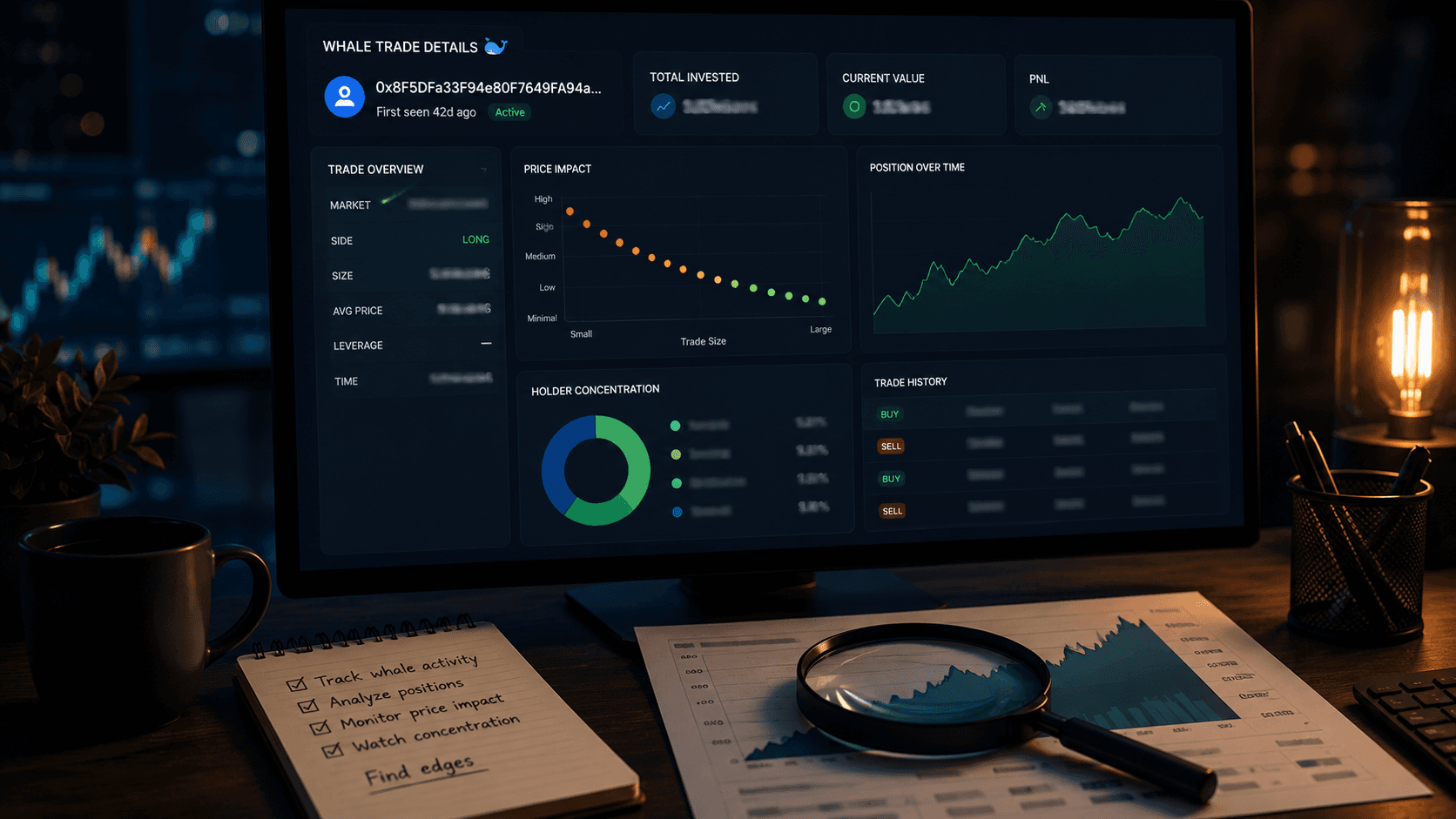
Open the Whale Positions view for that wallet on that market. Three possibilities:
- New position: They are entering for the first time. Strongest signal of fresh conviction.
- Adding to an existing position: They are leaning in. Strong, but you should ask why now.
- Closing or trimming: Their "buy" might actually be the counterparty taking the other side. Or their sell is just a partial profit take. Position context flips the meaning of a single trade.
A pro never trades on a Live Feed entry alone without checking what it does to the position.
4. Did the Trade Move the Market?
A $100k buy that barely moved the price tells you the order book absorbed it: someone with comparable size sold into them. That is two whales disagreeing, not one whale dominating.
A $30k buy that moved the price 6 cents tells you the book was thin and the trader prioritized speed over fill quality. That signals either urgency or sloppy execution.
The relationship between size and price impact tells you about liquidity and opposition, both of which matter more than dollar amount.
5. Is There a Real Catalyst?
Whales rarely act in a vacuum. There is usually a reason they are taking a position now and not last week or next month.
Quick check:
- Major news in the last 24 hours?
- Upcoming event (election, sports fixture, Fed meeting, earnings)?
- A related market just resolved or moved?
- A pattern of wallets clustering on the same side over a few days?
If you cannot identify any plausible catalyst, you are looking at one of three things: information you do not have access to, a hedge against something off-platform, or a bad trade. None of those are guaranteed wins for you.
6. Are Other Smart Wallets on the Same Side?
One smart wallet is information. Three smart wallets independently reaching the same conclusion is a much louder signal.
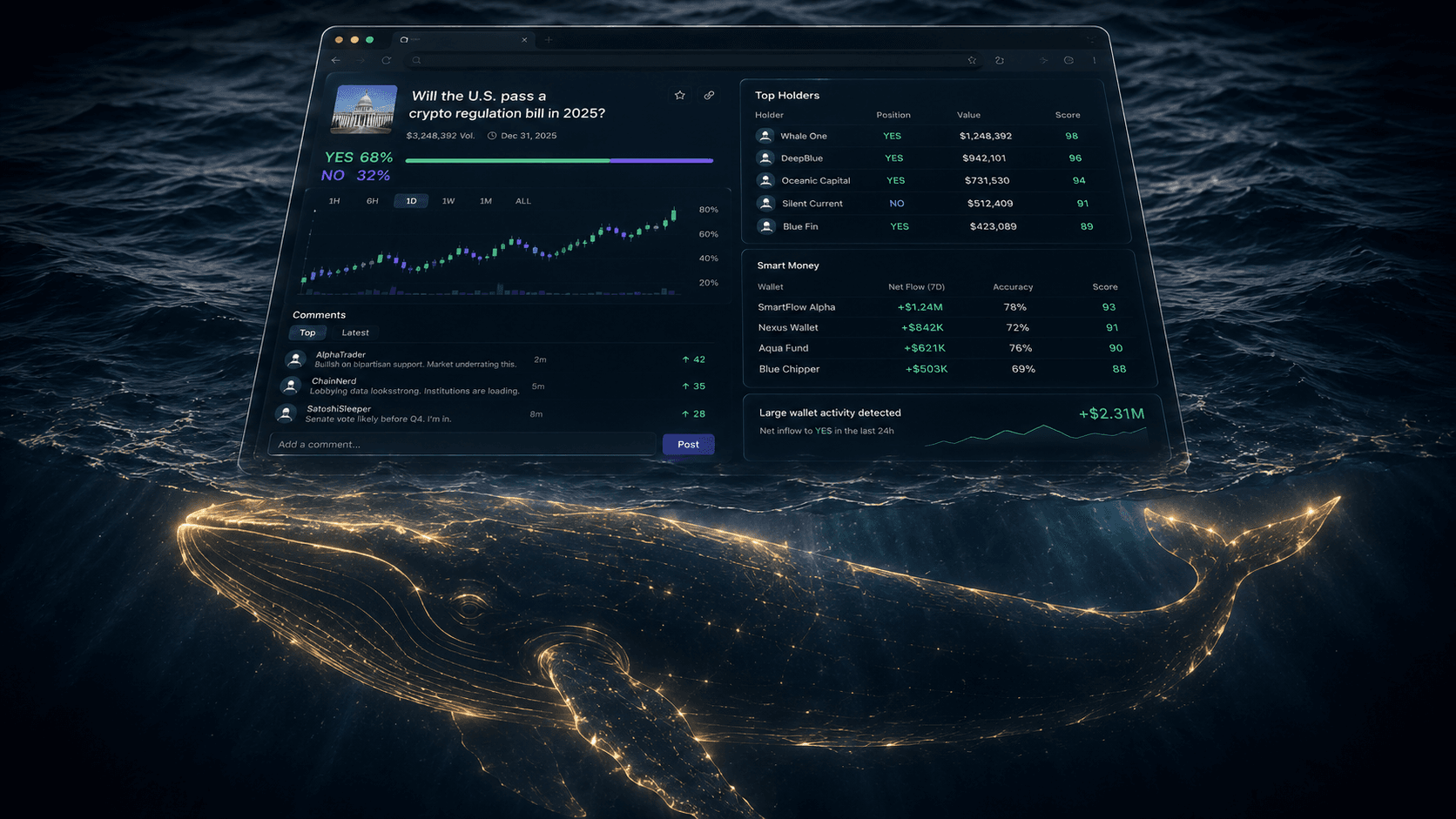
The Smart Money Tracker lets you see this directly: what percentage of one side of a market is held by high-scoring traders versus low-scoring ones. If your alert wallet is on the same side as a meaningful concentration of other vetted wallets, the conviction stack is real.
If they are alone, or worse, if other smart wallets are quietly on the other side, the trade you are tempted to copy might already be the wrong side.
7. What Are the Fresh Wallets Doing?
Sometimes the most informative thing on a market is not the biggest known whale. It is a sudden cluster of brand-new wallets piling into one outcome.
Pull up the Fresh Wallet Tracker. Are fresh wallets unusually active here? Are they on the same side as your alert wallet, or against them? A whale plus a fresh wallet wave on the same side, in a niche market, is the kind of confluence that experienced traders take seriously. We covered the deeper context in How to Spot Smart Money on Polymarket.
Telling Conviction Apart From Hedges and Wash
A huge amount of whale activity is not what it looks like on the surface. Pros learn to recognize the difference between conviction trades and three other patterns.
Hedges look like big buys but are really insurance. A wealthy trader heavy in one asset class buys a Polymarket outcome that benefits from the opposite scenario. Their trade does not say "I think this will happen." It says "I want to be protected if it does."
How to spot it: the trade is large in absolute dollars but small relative to the wallet's external exposure. Often appears around macro markets, geopolitical risk, and rate decisions.
Wash trading looks like activity but is really self-trading or coordinated trading between related wallets. Volume goes up. Price barely moves over time. The same handful of wallets keep filling each other.
How to spot it: low net position change despite high volume. Same counterparties appearing across days. Common in low-liquidity, niche markets.
Distribution is when a profitable wallet quietly exits a winning position into rising prices. On the tape, the price keeps climbing. On the position, the smart money is leaving. Retail buys the strength while informed money cashes out.
How to spot it: rising price plus declining top-holder positions. The Positions view is the only way to see this clearly.
Conviction, by contrast, looks like a clean new position from a vetted wallet, in their lane, with a plausible catalyst, ideally with other smart wallets nearby. That is the trade worth your attention.
Why "Size" Is the Worst Part of a Whale Alert
Most traders read whale alerts size-first. "Wow, $200k! Must be huge conviction." That is exactly backwards.
Size tells you almost nothing without context:
- $200k is a fraction of a percent of a major political market's daily volume.
- $200k can completely overwhelm a niche market.
- $200k from a wallet that routinely trades $1M is medium activity.
- $200k from a wallet that usually trades $20k is a 10x outlier.
What actually matters is relative size: relative to the market, relative to the wallet's typical behavior, and relative to the rest of the order book.
Pros mentally normalize size before they react. Beginners react to the headline number.
Sizing and Timing Your Own Response
Once your analysis says "yes, this is a real signal in my favor," the next question is how to actually express the trade.
A few rules experienced traders use:
1. Limit orders by default.
The whale already paid the spread. You do not have to. Set a limit order at a price you would actually be happy holding to resolution. If the market runs without you, fine, that is a missed trade, not a losing trade. Limit Orders vs. Market Orders Explained covers the math.
2. Size to your conviction, not theirs.
The whale is risking what is small for them. You should risk what is small for you. Their dollar amount is irrelevant input to your sizing.
3. Define your exit before entering.
At what price do you take profit? At what price do you accept you were wrong? Whale flow does not exempt you from having a plan.
4. Re-check positions before resolution.
If the whale you are following starts trimming, you have new information. Either trim with them, or know that your conviction now diverges from theirs.
5. Track your own results against their alerts.
After 30 to 60 days, ask: did the trades I took based on Wallet X's alerts make money? If not, demote them in your watchlist. Real edge shows up in your own PnL, not just theirs.
Putting It All Together
Here is the analyst-grade workflow in a single sequence:
- Alert fires from Whale Alerts or a tracked wallet.
- Vet the wallet on the Traders Leaderboard.
- Confirm the lane: are they trading their specialty?
- Check Positions: building, adding, or closing?
- Read price impact and liquidity in the order book.
- Identify the catalyst: why now?
- Cross-check smart and fresh wallet flow for confluence.
- Form your own thesis and write down your exit conditions.
- Use a limit order sized to your conviction.
- Review the outcome, update the watchlist if needed.
Most whale alerts will not survive that funnel. That is the point. The system is not designed to maximize trade count. It is designed to minimize bad trades.
Conclusion
Pros do not analyze whale trades to find the next obvious copy. They analyze whale trades to disqualify most of them, keeping only the rare alerts where everything aligns: a vetted wallet, in their lane, building (not exiting), with a real catalyst, supported by other smart money, and sized correctly relative to the market.
That is what separates a research-grade whale workflow from a copy-trading hobby. The first compounds capital over time. The second is just an expensive way to mirror someone else's mistakes.
Resources:
Frequently Asked Questions
What is the first thing to check when a whale alert fires?
Who the wallet actually is. Resolved trade count, lifetime PnL curve, and category fit. An alert from an unvetted wallet is not a real signal, no matter how big the dollar amount.
How do I tell if a whale trade is conviction or a hedge?
Hedges usually appear in macro, political, and geopolitical markets and tend to be inversely correlated with the wallet's known external exposure. Conviction trades fit the wallet's specialty, build a fresh position, and often coincide with a clear catalyst. The Positions view on Whale Positions is the cleanest way to confirm direction.
Should the size of a whale trade drive my decision?
No. Relative size matters far more than absolute size. A $50k trade can be tiny in a deep political market and enormous in a niche regulatory market. Pros normalize size against market depth and the wallet's own history before they react.
How do I avoid getting faked out by distribution?
Always cross-check the Whale Positions view. If the price is rising while top-holder positions are shrinking, smart money is exiting into retail strength. The tape looks bullish, but the position context is bearish.