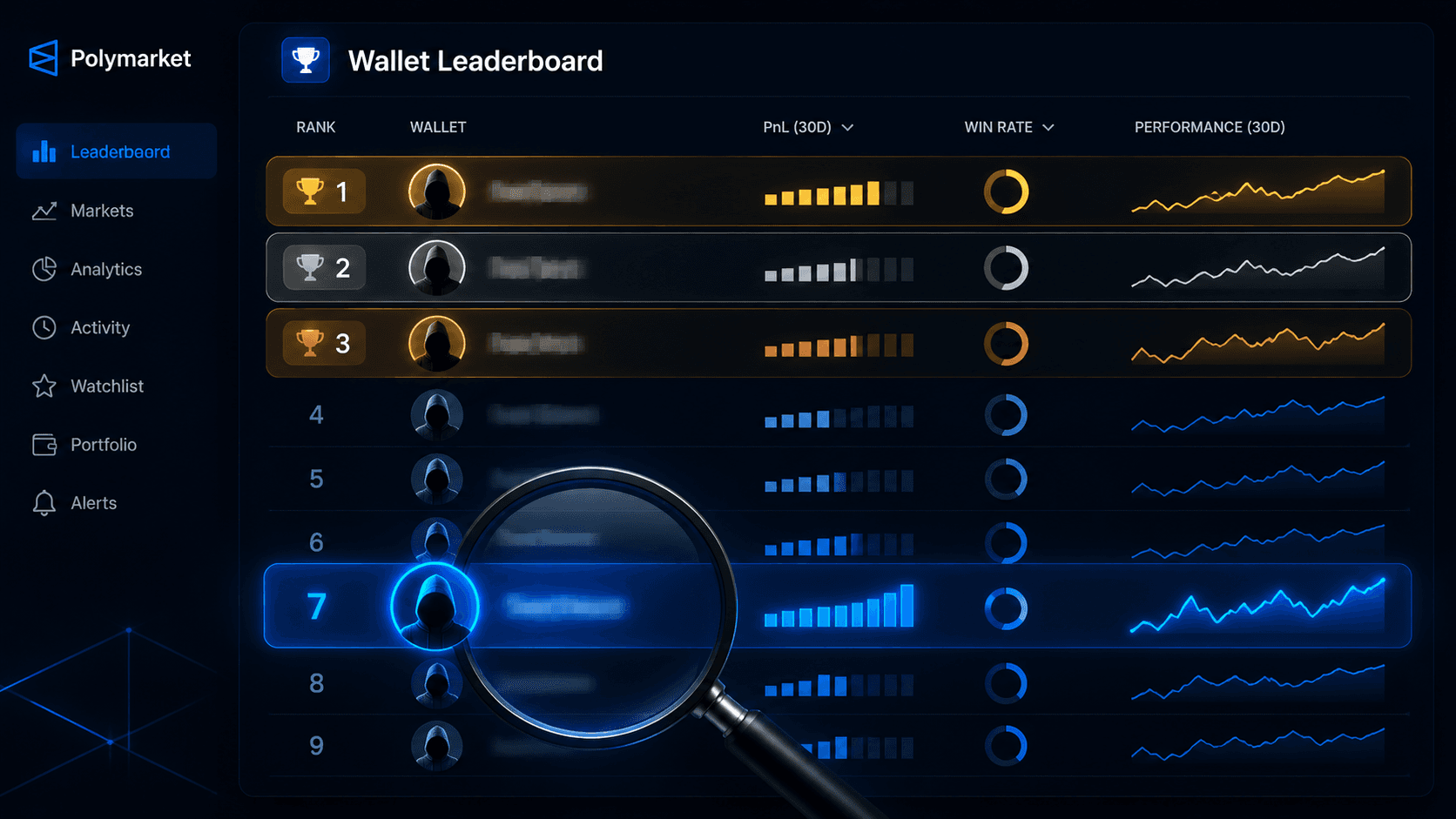
Polymarket Smart Money and Market Correlation: The On-Page Signals Most Traders Miss
When most people talk about "tracking Polymarket," they mean two things: looking at the whale leaderboard and watching prices. That is a perfectly reasonable starting point, and most traders never get past it.
The two signals that actually move decisions for experienced Polymarket traders are quieter, harder to surface, and almost never read in real time:
- Smart money conviction — verified profitable addresses building meaningful positions in a specific market.
- Cross-market correlation — other markets whose prices move with the one you are looking at.
Both are quietly priced into outcomes by the people who pay attention to them. Both are now available directly on every polymarket.com/event/... page through the free PolyAlertHub Insights extension, in tabs sitting next to Polymarket's native comments.
This guide is about reading those two signals well.
What You Will Learn
- Why smart money conviction is the cleanest signal in a prediction market
- How to distinguish genuine sharp accumulation from background noise
- What correlation actually tells you (and what it does not)
- A simple framework for using both signals together
- The mistakes that turn these signals into noise
Key Takeaways
- Smart money conviction is about who, how many and which side. Several high-scoring wallets agreeing on one outcome matters far more than one big order.
- Context changes the weight of the signal. Sharp accumulation in a quiet, niche market usually carries more information than the same flow in a headline event that is priced in seconds.
- Always ask why two markets are correlated. Shared narrative, logical entailment and coincidence look identical in a list, but only the first two are worth trading on.
- Correlation is descriptive, not predictive. Use it to find a better-priced expression of a view, to build a hedge, or to notice when a relationship breaks.
- The strongest reads combine both signals. Smart money moving one market while a closely linked market has not reacted yet is the classic setup to investigate.
- Both tabs live on the Polymarket page. The free PolyAlertHub Insights extension shows them next to the comments, so checking them costs seconds.
Signal One: Smart Money Conviction
Not all Polymarket volume is created equal. Most is simply retail churn — Polymarket onboards new accounts every day, and the vast majority of them follow social media hype.
What matters is a specific pattern: high-win-rate traders with proven category track records building meaningful size on one specific outcome, especially before a known catalyst.
Experienced traders who specialize in a particular niche (e.g. macro indicators, legal proceedings, or elections) rarely deploy capital randomly:
- Category Edge: Traders with high PolyScore rankings have demonstrated calibrated probabilistic edge across dozens of resolved contracts.
- Timing & Asymmetry: When multiple high-performing wallets enter the same outcome in a short window without a public headline, they are often reacting to early modeling or deep domain analysis.
When smart money positioning is concentrated (heavy bias toward one outcome) and sized meaningfully (high dollar commitment relative to normal trade sizes), following that flow provides a significant probabilistic edge.
Reminder: Smart money tracking is an analytical input, not a guaranteed win. Even elite traders experience drawdowns. Looking for confluence between multiple sharp traders is what raises the bar.
How to Read the Smart Money Tab
Open any Polymarket event page with the extension installed. Click the PolyAlertHub logo tab on the right edge. Switch to Smart Money. You will see top-performing addresses that have taken positions in this specific market, ranked by conviction score and size.
Three questions to ask:
- How many sharp wallets? One high-scoring wallet is a data point. Three to five in an otherwise quiet market is a strong signal.
- Which side? All on YES, all on NO, or split? Heavy consensus on one side is the strongest version of the signal.
- What is their average entry price? Are they buying early at favorable odds, or chasing price after the market has already moved?
For background on the broader dataset behind this tab, see the Smart Money Tracker. For the scoring logic itself (why a wallet counts as "sharp", and how the worst-performing wallets can be read as a contrarian signal), see how to spot smart money on Polymarket.
Common Mistakes With Smart Money Signals
Mistake 1: Blindly copying single orders. Even high-win-rate traders make mistakes. Look for multi-wallet consensus rather than mirroring a single wallet. The same discipline applies to large trades in general; how to analyze whale trades like a pro lays out the questions to ask before following any single order.
Mistake 2: Ignoring market context. Smart money accumulation in a niche, low-liquidity market often carries far more informational value than trades in high-volume, global headline events where news is instantaneously priced.
Mistake 3: Not checking for opposing smart money. When top-scoring wallets are positioned heavily on both sides, the market is sharply contested and edge is minimal.
Signal Two: Market Correlation
The Correlation tab shows other Polymarket markets whose prices move together with the one you are viewing. It looks like a simple list. It is not.
What Correlation Actually Tells You
There are three reasons two markets can be correlated:
1. Shared underlying narrative.
"Will Candidate X win the primary?" and "Will Party Y win the general?" are correlated because they both depend on the same political environment.
2. Direct logical entailment.
"Will X exceed Y by date Z?" and "Will X be the highest of W, X, Y, Z?" share resolution conditions.
3. Coincidence in the time window.
Two markets happen to have moved together for the last week without any real underlying linkage. This goes away.
Reading correlation well means asking which one this is before trading on it.
Three Useful Things to Do With the Correlation Tab
A. Find a better expression of the same view.
You like the YES thesis on Market A. The Correlation tab shows Market B is 0.9 correlated. Compare:
- Liquidity (which has tighter spreads?)
- Mispricing (does one look richer than the other relative to the shared narrative?)
- Resolution timing (which resolves cleaner?)
If Market B is just a better-priced version of the same view, take Market B.
B. Build a hedged pair.
If two markets are tightly correlated and one is mispriced relative to the other, that is a pair trade — long the cheap side, short the rich side, neutral on the underlying narrative.
C. Detect when correlation breaks.
Two markets that have been moving together for weeks suddenly diverge. Either one of them has new information, or the correlation was always coincidence. Either way, that is worth a closer look.
What Correlation Does Not Tell You
Correlation is descriptive, not predictive. The fact that Market A and Market B have moved together does not promise they will continue to. Use it to find candidates, not to commit to a thesis.
Putting Them Together
The most useful reads come from combining the two signals.
Setup 1: Smart money conviction + correlated market mispriced.
High-scoring traders accumulate Market A on YES. The Correlation tab shows Market B is highly correlated with A. Market B has not yet moved. That is a window where Market B may be priced as if A had not moved — exactly the kind of inefficiency that closes once enough people notice.
Setup 2: Smart money disagreement + correlation as confirmation.
The Smart Money tab shows high-scoring wallets on NO. The price action is climbing on YES. The correlated markets are also drifting up. If the correlated markets reverse first, it is a leading indicator that the smart money read is starting to play out.
Setup 3: Sharp conviction without correlation context = treat carefully.
Smart money accumulation on a market with no clean correlated peer means you cannot cross-check the signal against another surface. Size appropriately and manage risk.
Decision Table: What to Do When the Two Signals Meet
The three setups above are the clean cases. In practice you will see messier combinations, so here is a quick reference for the most common ones. "Smart money" means what the Smart Money tab shows; "correlated peer" means a market from the Correlation tab where you have already confirmed the link is real (shared narrative or logical entailment, not coincidence).
| Smart Money tab shows | Correlated peer shows | Reasonable read | What to do next |
|---|
| Several sharp wallets on one side | Peer has already moved the same way | Information is largely priced in | Look for a better entry rather than chasing; set a price alert |
| Several sharp wallets on one side | Peer has not moved | Possible lag between linked markets | Compare liquidity and spread on both; consider the cheaper expression |
| Sharp wallets on one side | Peer moving the opposite way | Either the link broke or one market is wrong | Re-check why the markets are linked before acting at all |
| Sharp wallets split across both sides | Anything | Contested market, little edge from flow | Stay out unless you have your own independent view |
| One sharp wallet only | Peer quiet | Single data point | Watch; wait for confirmation from more wallets |
| No sharp wallets | Peer moving sharply | Move driven by other participants | Treat as a price movement story, not a smart money one |
A hypothetical worked example
The numbers here are made up to show the arithmetic, and they ignore fees.
Say three high-scoring wallets have bought YES on Market A, which now trades at 60¢. The Correlation tab shows Market B, which resolves on the same underlying outcome a few days later, still trading at 48¢. You check the rules of both and confirm that if A resolves YES, B almost certainly does too.
With $100 to deploy on the view:
| Market A | Market B |
|---|
| Price | 60¢ | 48¢ |
| Shares for ~$100 | 166 ($99.60) | 208 ($99.84) |
| Payout if YES | $166.00 | $208.00 |
| Profit if YES | $66.40 | $108.16 |
| Loss if NO | $99.60 | $99.84 |
The downside is about the same, but B pays roughly $42 more if the shared thesis is right. Before taking B, run the checks from earlier: is its spread tight enough that you can actually get filled near 48¢, is there a reason B should be cheaper (a stricter rule, an extra condition, a longer wait for your capital), and are any sharp wallets on B's NO side? If B is cheaper for a real reason, the "discount" is an illusion.
If you want to test this kind of cross-market read without risking capital, paper trading on Polymarket lets you log both legs and see how often the lagging market actually catches up.
A Quick Workflow Recap
For active traders using the extension on polymarket.com:
- Top Holders — read the cap table.
- Smart Money — check whether scored wallets are on a side.
- Correlation — find better expressions, hedges, or confirmation.
- Order Flow & Depth — inspect liquidity and spreads.
- Set alerts at stop and target before placing the order.
The first four steps live on the Polymarket page itself, thanks to the PolyAlertHub Insights extension. The fifth lives one tab away in PolyAlertHub.
Final Word
The big, loud signals on Polymarket — volume, headline price moves, what crypto Twitter is loud about — are already priced. The signals that are not yet priced tend to be quieter: smart money conviction quietly building in a sleepy market, a correlated peer that has not moved yet, or a high-scoring wallet taking a disciplined contrarian stance.
These are exactly the signals that are easiest to ignore when you are tab-switching. They are exactly the signals an on-page extension is built to surface.
If you have not installed it yet, start with the extension overview. Then come back to this guide once you have it running and walk through a few markets.
The data has always been there. Now it is on the page.
Frequently Asked Questions
Is the PolyAlertHub Insights extension free?
Yes. The extension is free to install and adds Top Holders, Smart Money and Correlation tabs to Polymarket event pages in supported browsers. You can find install links on the extension page, and the extension overview covers each tab in more detail.
How many smart money wallets make a signal worth acting on?
There is no magic number, but one wallet is a data point and several wallets agreeing on the same side in an otherwise quiet market is a much stronger read. Also check average entry prices: sharp wallets that bought well below the current price have already captured much of the move.
Does a high correlation mean one market will follow the other?
No. Correlation only describes how prices have moved together in the past. It becomes useful when you can explain the link, for example two markets that depend on the same event, and much less useful when the relationship is coincidence that happened to hold for a few days.
Can I get alerts instead of checking the tabs manually?
The tabs are for reading a market while you are on it. For notifications, PolyAlertHub's Smart Money Tracker and price alerts run in the web app and can push to Telegram or email. Tracking smart money on Polymarket explains how smart money alerts are configured and how their results are tracked.
Keep Reading